
DVA led with falling suicide rates – then I read the full report!
Share the post "DVA led with falling suicide rates – then I read the full report!"

Dear Editor,
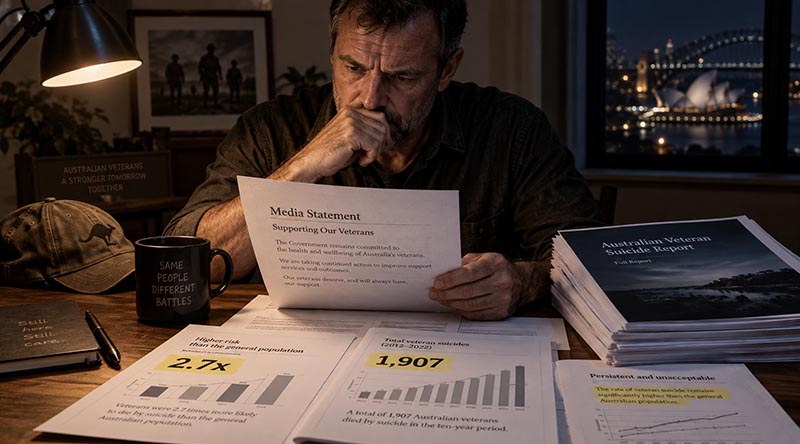
DVA led its latest suicide report with the welcome news that veteran suicide rates have generally declined.
But the full Australian Institute of Health and Welfare report also records 1907 suicide deaths since 1997 and shows medically separated men had 2.7 times the suicide rate of those who left voluntarily.
The newest figures are also still preliminary.
Those facts deserved equal prominence.

The Royal Commission wanted independent agencies properly funded to collect and publish this data. Veterans should not have to dig through reports to discover the harder parts of the story.
Good news should be reported.
So should the whole truth.
I expand on this at markcroxford.net/read
Mark Croxford
Founder, Veterans Count
20-year Navy veteran, and
former media and political adviser to a Minister for Veterans’ Affairs and Minister for Defence Personnel
.
.
ChatGPT image
EDITOR’S NOTE: A media representative from DVA phoned me to complain about this letter. He was quite upset, ‘wound up’ and repeated his complaint over and over (presumably for emphasis). His complaint was that the above letter was, in his opinion, “disingenuous and factually incorrect” – based on his assertion that DVA did not say what was claimed in the letter – it was AIHW who said what is claimed. The fact that DVA commissioned the AIHW report was of no interest or consequence to the DVA rep – who did actually suggest that the above letter should be deleted.
After reviewing the DVA public statement and the AIHW report, I disagree that the above letter is factually incorrect. I stand by the author’s right to his opinion and my decision to publish the letter.
.
.

.
.




Some 15+ years ago, a group of mental Health qualified nurses proposed the establishment of an inpatient and outpatient mental health unit. We suggested that 1 Psych Unit (now off the orbat) be an HR unit with 2 Psych Unit being a clinical care unit. Evidence tells us that engagement is one of the best ways to help people with mental health conditions to get better. Reserve officers working in civilian mental health units struggled to ensure military members stayed connected to their mates. One of the rules for people suffering with suicidal ideation is to keep them engaged and feeling useful. In other words, unless there is a clinically indicated reason keep the individual with their mates until they either improve or need more urgent care. There is never any middle ground. What did Defence do? Got rid of psychology corps, did not accept that there was a need for mental health qualified nurses in the ADF and treated those with mental health issues as lepers. There is anecdotal evidence that members saw external GPs for antidepressants and then showed serotonin reactions, after running out of their medication. This made the individuals in effective in the operational setting. We need to promote the evidence and not embrace risk aversion at all cost, including the price the individual pays for being abandoned. Each and every suicide is, in my mind, a failure of leadership at all levels, including political.