
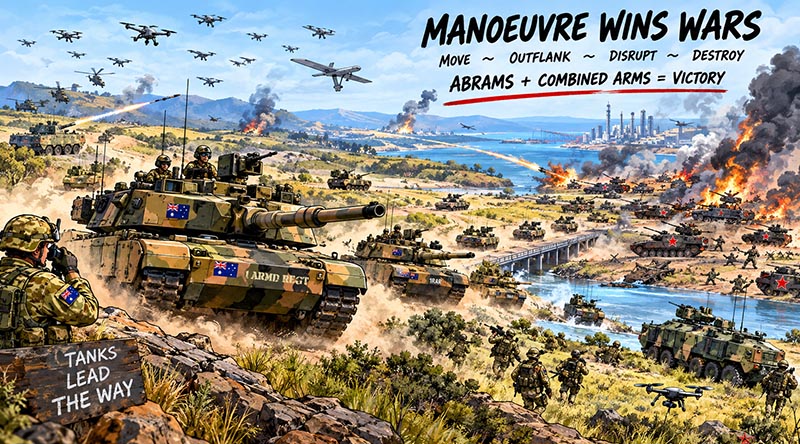
The importance of manoeuvre

Manoeuvre warfare has been the touchstone of doing battle since the trenches of the First World War. Has its importance come to an end?
Traditionally, it is a strategy which identifies and attacks the enemy’s weaknesses, while avoiding his strengths.
Often referred to as the ‘indirect approach’, it involves by-passing enemy strong points, capitalising on surprise, and disrupting the enemy’s decision making. Rapid and unexpected advances are a hallmark of manoeuvre warfare.
Although there’s a lot of discussion regarding the use of the term blitzkrieg (lightning war), it conveys a concept exploited by the Germans during the Second World War. This is another example of manoeuvre warfare.
Attrition warfare, on the other hand, is the exact opposite – pitting one’s own strength directly against that of the enemy.

The benefits to be achieved through manoeuvre apply not just at the tactical level, but at the operational and strategic levels as well.
The secret to manoeuvre warfare is breaking the enemy’s will to fight by thinking and moving faster than his decision-making can cope. Critical elements are the use of initiative, originality and the unexpected.
An article published by the US Marine Corps Association: “Implications from Operation IRAQI FREEDOM for the Marine Corps”, concluded: “Iraqi Freedom was a remarkable military victory. Manoeuvre Warfare moved from being a theoretical doctrine to a real battlefield, where it proved itself.”
Used correctly, armoured/combined arms forces can achieve results which far exceed that to be expected from their nominal strength. Significantly, they have the flexibility and agility to maintain and exploit initiative.
The crucial question, of course, is what threats will the ADF need to deal with in the foreseeable future? Will manoeuvre warfare play a part?
It must! What Army would seek to directly attack the enemy’s main strength?
How will the Australian Army deploy to meet its next adversary?
Will the Chief of Army allocate a separate battlegroup headquarters to command 1st Armoured Regiment (and relocate it to Townsville as a tank regiment) and will 2nd Cavalry Regiment return to being a single-role cavalry unit? Will 2/14 LHR (QMI) be allowed to remain an ARA unit?
These are the questions which the Chief must answer. They directly affect the Australian Army’s manoeuvre capability.
As General James McConville, Chief of Staff, United States Army, said: “You don’t need tanks – unless you want to win”.
Lieutenant Colonel Bruce Cameron, MC, RAAC (Ret’d)
.
.
ChatGPT image
.
.

.
.


