
RAN hydrographers top UK course

Two Royal Australian Navy officers have graduated from the Royal Navy’s redesigned Advanced Survey Course, with one finishing top of the class.
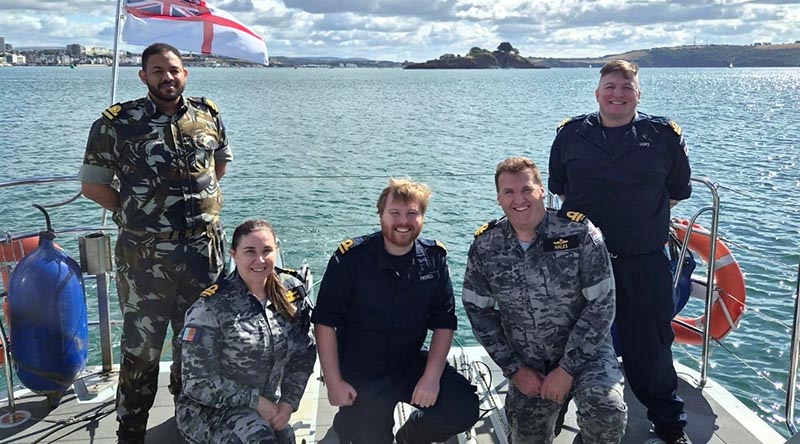
CAPTION: Graduates of the the Advanced Survey Course conducted at HM Naval Base Devonport, UK, including Royal Australian Navy students Lieutenants Djena Jordan, second from left, and Tim Hales, second from right, with students from the Royal Navy and the Royal Navy of Oman. Photo supplied by ADF.
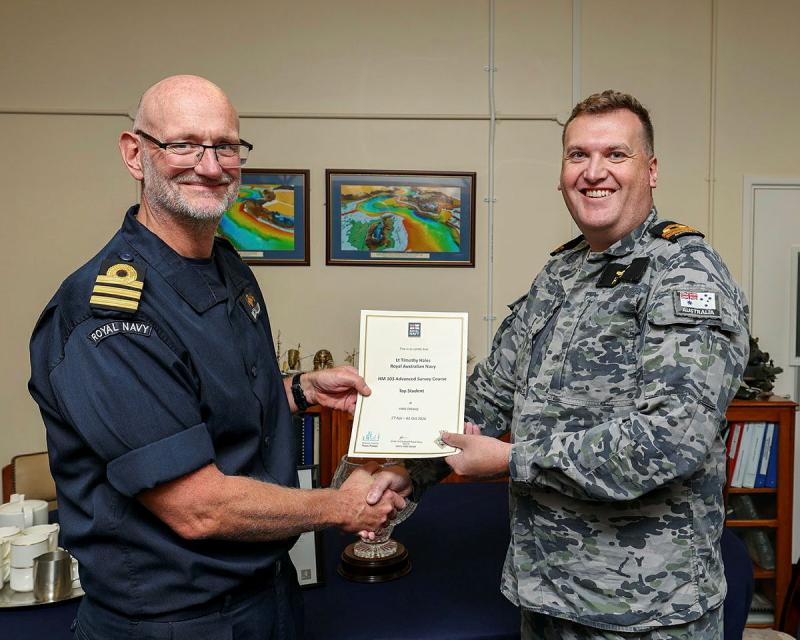
Lieutenant Tim Hales took the academic top spot and was awarded the David Croft Bowl for his contribution to cohort morale and wellbeing.
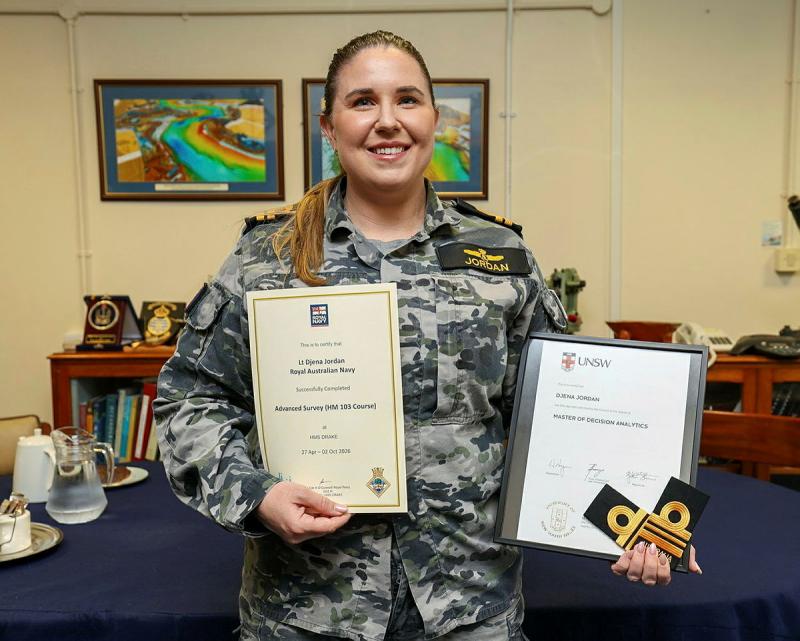
Lieutenant Djena Jordan marked a triple achievement by completing the course, finishing her master of decision analytics and being named on the latest Navy promotion signal.
The newly designed 20-week course, at the Hydrographic and Meteorological Training Unit (HMTU) at HM Naval Base Devonport in the UK, is the first run of a new curriculum, which pairs traditional surveying with autonomous systems and the ethical use of artificial intelligence.

Lieutenant Hales said he relished the opportunity to study alongside students from the UK’s Royal Navy and the Royal Navy of Oman.
“Success in adopting autonomy and emerging technologies depends on the people, relationships and trusted partnerships that enable them,” Lieutenant Hales said.
“We are already seeing the impact autonomous systems are having on survey work.
“They can undertake dull, dirty and dangerous tasks, increasing the speed and scale of survey operations.
“The diverse perspectives of Royal Navy and international colleagues enriched the training experience and created lasting professional connections.”
Lieutenant Djena Jordan, the first RAN officer to complete an exchange with the UK Hydrographic Office, said autonomous systems had put hydrographic data back in the spotlight, but the need for accurate data to keep mariners safe never changed.
“Partnerships with other navies and hydrographic offices are so important,” Lieutenant Jordan said.
“The data collected can have a significant impact on mariners around the world.”
RAN influence also shaped the course itself.
After feedback from former RAN student Lieutenant Dave Picker, the first week became a dedicated practical skills refresher.
HMTU’s Lieutenant Commander Heather O’Connell said international trainees brought vital real-world experience of surveying in vastly different geographic environments, and that key changes to the curriculum came directly from their feedback.
Australia’s Naval Advisor in the UK, Captain Rebecca Levitt said that, as Australia and the UK deepened cooperation under AUKUS, shared standards and trusted people-to-people links in areas such as undersea domain awareness became increasingly important.
“Training alongside the Royal Navy builds skills and trust we can’t replicate at home,” Captain Levitt said.
“Our hydrographers return with fresh experience and our partners benefit from what we bring to the classroom.”
.
.

.
.


