What can be done to save the Royal Australian Armoured Corps?
Share the post "What can be done to save the Royal Australian Armoured Corps?"

The need to save the RAAC is both obvious and urgent.
1st Armoured Regiment has been stripped of its tanks and made into an experimentation unit; while the 2nd Cavalry Regiment has been forced to adopt incompatible dual roles.
Saving the RAAC involves returning 3 Brigade (Townsville) to the armoured brigade it was intended to be when the Defence Strategic Review was published; i.e. a brigade comprising a tank regiment, a cavalry regiment, and a mechanised infantry battalion.
As much as it is possible to put a favourable spin on it … the then Chief of Army was forced by his Defence cohort to create an Army experimentation unit (then again, maybe this was a decision that the Chief himself wanted and whole-heartedly supported).
Whatever the circumstances, the Chief of the Defence Force approved what amounted to a significant weakening of Army’s combat power; the supposed ‘armoured brigade’ in Townsville, being left short one battle-group headquarters, a tank squadron and a cavalry squadron.

RAAC Representative Honorary Colonel has pointed out that:
“The creation of an Experimental Unit in Army is sensible and useful, but it has no relationship with 1 Armd Regt. That is, the two are separate ideas and calling the Experimental Unit 1 Armd Regt is both unnecessary and actually confusing.
The best operational outcome for Army is to form two battlegroups in Townsville, one commanding the cavalry and one commanding the tanks. This has benefits for training and operational focus.
The best way to achieve this outcome is to raise RHQ 1 Armd Regt in Townsville and to assign the tanks to it”.
Is he right … or is the day of the tank something to be consigned to yesteryear?
The headline in a recent UK Daily Telegraph said: “We are witnessing the death of tank warfare”. Is it too late? Could it be that ‘drones have done to tanks what muskets did to knights in armour’? Should tactics be changed, or would this be premature?
There is no doubt that tactics must change. It’s the nature of that change which must be considered carefully. Units that can adapt the quickest, will have a significant advantage.
Integrating layered active counter-drone defences such as shooting them down and jamming their navigation systems, along with passive defence measures such as camouflage, will be the key.
It would be completely wrong to remove tanks from the ORBAT. Infantry have always been the key element of operational commitment and this will remain the case. They must, of necessity, be provided with close fire support. It is unthinkable that this would not be so (resulting in a return to the era of trench warfare).
A tank regiment is a unique Army unit; one forged by the bonds that bind its crews.
Whether providing close fire support for infantry or engaging other tanks, a tank regiment is one committed to closing with and destroying the enemy. It’s whole ‘raison d’etre’ is focused on this.
The scrapping of 1 Armd Regt forced the 2nd Cavalry Regiment to adopt incompatible dual roles: providing close fire support to infantry (two squadrons of tanks); while also conducting reconnaissance for 3 Brigade (two squadrons of recon vehicles).
Surprisingly, the unit’s CO opted to boast that:
“From the start of 2025, the 2nd Cavalry Regiment will be home to all of the Australian Army’s combat-ready tanks and the majority of its ASLAV fleet, becoming the heaviest and most combat-capable manoeuvre regiment in the Australian Army”.
The very fact that this should have happened, indicates just what a dire situation, the RAAC finds itself in.
The only solution – to adopt the recommendations of the RAAC Representative Honorary Colonel.
BUT, neither the RAAC Corps Council nor Major General Michael Krause, has the authority to implement such a change.
So, where to from here?
PART 2 HERE …
Lieutenant Colonel Bruce Cameron, MC, RAAC (Ret’d)
.
.
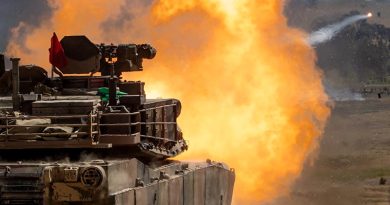
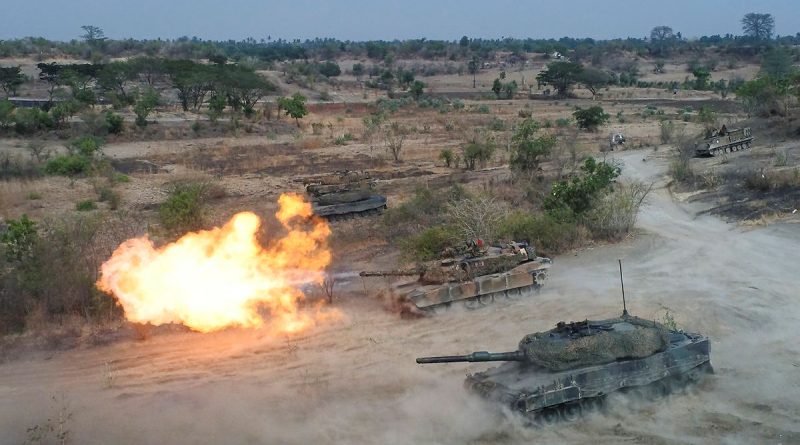
FILE PHOTO: An Australian Army M1A1 Abrams fires while working side-by-side Indonesian National Armed Forces Leopard 2 tanks during a combined joint live-fire practice on Exercise Keris Woomera 2024 in East Java, Indonesia. Photo by Leading Seaman David Cox.
.
.

.
.