
1 Armd Regt’s experimental repair shop

A small drone with a broken wing is retrieved from scrubland at Cultana and taken to a converted stores module with advanced manufacturing technologies.
Within minutes, the part is scanned, redesigned on a laptop and fed into a machine ready to manufacture a replacement on site.
The Australian Army’s 1st Armoured Regiment (1 Armd Regt) – which was stripped of its tanks in 2024 to become an experimentation unit – used Exercise Black Prince 3 to get a glimpse of a future where sustainment might keep pace with manoeuvre.
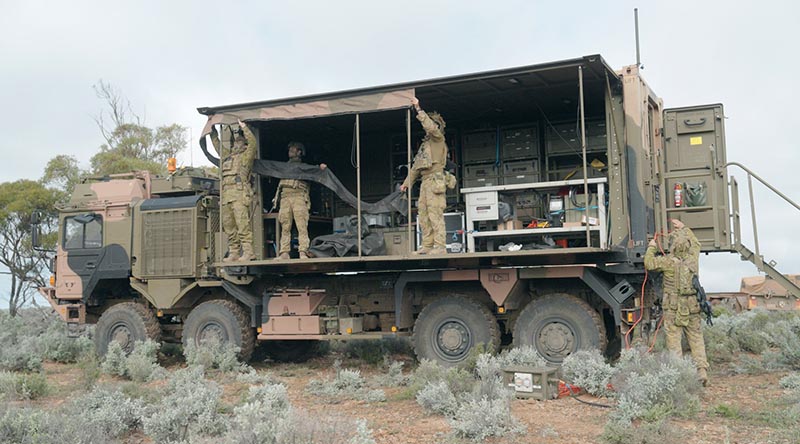
CAPTION: Soldiers from 1st Armoured Regiment set up their deployable advanced manufacturing shelter during Exercise Black Prince 3, at Cultana Training Area, South Australia. Photo by Michael Guo. Original story by Emma Kennedy, edited by CONTACT.
1 Armd Regt is trialling a deployable advanced-manufacturing shelter designed to support rapid battle-damage repair and equipment modification with emerging technologies in the field.

Packed into a deployable container are computer-aided design systems, 3D-printing technology, scanning equipment and CNC machining capability.
The shelter was designed and developed by the regiment to test how advanced manufacturing could support robotic and autonomous systems during deployed operations.
Commander 1 Armd Regt Lieutenant Colonel Matt Sebesfi said it had already shown strong operational potential.
“The advanced manufacturing shelter provides a unique and very useful capability,” Lieutenant Colonel Sebesfi said.
“It allows end-to-end manufacturing and complete reverse engineering of components in the field.
“We can retrieve a damaged part, conduct a 3D scan or manually conduct computer-aided design, and then fabricate and produce a temporary replacement that could be fitted to our equipment.”
For Captain Sebastien Beoutis, the trial addressed a growing challenge – how can the ADF effectively sustain forces across dispersed and contested environments?
“The container has only been in our possession for about eight weeks and we’ve been able to rally the guys together and form a functioning capability. That’s really something I’m very proud of,” Capt Beoutis said.
“As Army prepares to fight wars in the littoral, Capt Beoutis said.
“Sustainment systems have to evolve.
“If we’re going to be island hopping, we can’t rely on long, vulnerable supply chains – the repair parts and sustainment must move with us.”
Craftsman Mark Coonan said the shelter had immediate practical value for maintainers in the field.
“If we need parts for a mission-critical component that has broken, we can get it back up and going in the shelter,” he said.
Commander Joint Logistics Unit –Victoria Colonel Phillip Baldoni said advanced manufacturing would play an increasingly important role in sustainment.
“If we can shorten supply lines, reduce the amount of material that has to go back across vulnerable lines of communication, we give commanders greater certainty to achieve their mission,” Colonel Baldoni said.
“If we don’t embrace advanced manufacturing, then we risk leaving a tool on the table that allows us to adapt quicker than our adversaries.”
.
EDITOR’S NOTE: This activity was photographed on 25 May 2026, with the story published by the new-look ARMY Newspaper web site on 10 August.
.
.

.
.


Back in the 70s, I was the handsome senior tradesman (artificer/warrant officer) in charge of providing the 1st Armoured Regiment’s Leopard tanks as close to the ‘frontline’ as possible. Sadly I only held that job for two years before I moved on. I loved every minute …and still following news on where/when/what 1AR (1 Armd Regt) is doing. I’ve been interested in this famous unit’s tanks from before they went to Vietnam in the 60s.
Then today, as I looked at what Google’s algorithm had fed me to read or watch…I read in this article that “ the tanks are gone” …surely not true? Perhaps now the regiment’s squadrons are dispersed/attached to various brigade formations? I know, I know …the robots/drones are here …but manned, mobile, armoured, close-in direct fire support will be needed to support the ‘men on the ground’ until they’re replaced by robots I guess…sometime soon. PS. Loved the article …more like this please (keeps me aware). I left the military as CO at Fort Queenscliff in 1993 after 3 decades in uniform. Cheers! Arte et Marte.