
Regiment restores assault pioneer capability
Share the post "Regiment restores assault pioneer capability"

Soldiers from the 1st Battalion, Royal Australian Regiment (1RAR), have reintroduced the ‘assault pioneer’ capability through a course to restore breaching and mobility skills within the battalion.
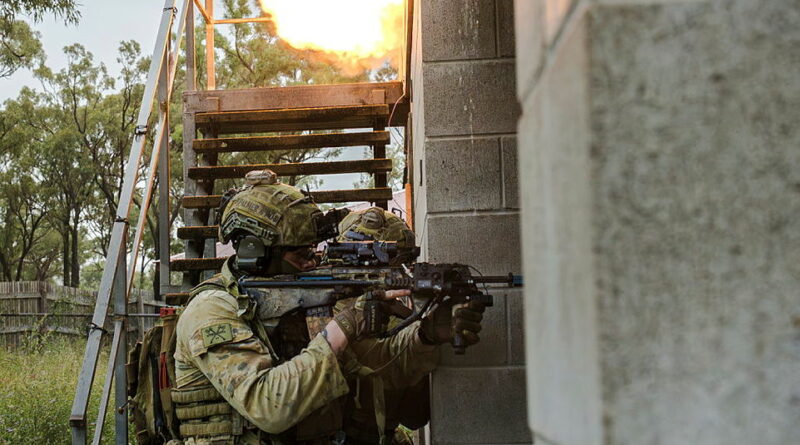
CAPTION: Soldiers from the 1st Battalion, Royal Australian Regiment, and 3rd Combat Engineer Regiment explosively breach a doorway during the Basic Assault Pioneers Course. Story by Captain Andrew Page. Photo by Lance Corporal Andrews.
Assault pioneers trace their origins to World War I, with the capability later reduced and eventually removed from infantry units in the early 2010s.
A renewed focus on mobility and survivability has driven efforts to restore the capability.
For Sergeant Rowan Osland, the course provided an opportunity to build new skills and operate in a role outside his previous experience as a combat radio operator.


CAPTION: Soldiers move to the form-up point before carrying out an urban assault during the Basic Assault Pioneers Course at Townsville Field Training Area. Photo by Sapper Oliver McKenzie.
“We’ve completed our culminating activity, conducting section battle drills, breaching and clearing multiple buildings,” Sergeant Osland said.
“The training qualifies us not just to conduct breaches, but to manage safety and fulfil all required safety appointments.”
The training has equipped soldiers with the skills to conduct explosive breaching, enabling infantry to maintain momentum during urban operations and reduce delays at obstacles.
Platoon Commander 1RAR Lieutenant Eric Du Preez said the reintroduction of assault pioneer capability reduced reliance on external specialist support and increased operational flexibility.

CAPTION: Soldiers prepare to explosively breach a doorway during the Basic Assault Pioneers Course at Townsville Field Training Area.
“Engineer assets will always be in high demand in any operational context.
Assault pioneers give infantry the ability to support their own operations across a broad range of tasks and work more closely alongside engineers,” Lieutenant Du Preez said.
“Assault pioneers have a long history within the Australian Army and as the focus shifts back to the near region, the importance of the capability is re-emerging.”
The training forms part of a broader progression.
“Following this, we’ll move into demolitions, watermanship and field engineering to cover a broader range of engineer tasks, before taking part in North Queensland Warfighter as the platoon’s first major exercise supporting battle group operations,” Lieutenant Du Preez said.

CAPTION: Private Jared Palmer, of 1st Battalion, Royal Australian Regiment, provides security during the Basic Assault Pioneers Course at Townsville Field Training Area, Queensland. Photo by Lance Corporal Andrews.
.
.

.
.


About time 019 returned.
In the 21st century, advanced MOUT should be a basic infantry skill, not an ‘add-on’. Ditto for RPV/FPV training. What other skills does Contact think should be considered ‘basic’ for a RAR PTE?