Peregrine starts Top End missions

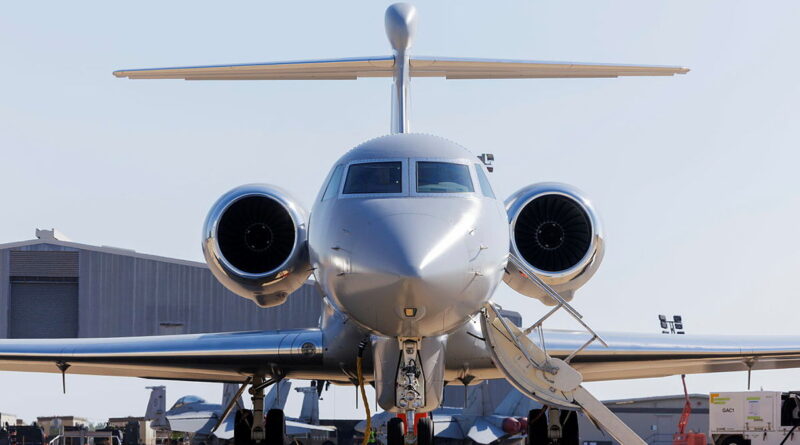
An MC-55A Peregrine from the Royal Australian Air Force’s 10 Squadron deployed to RAAF Base Darwin this month for its first operational test and evaluation (OT&E) flights.
CAPTION: A RAAF 10 Squadron MC-55A Peregrine on the apron at RAAF Base Darwin. Story by Squadron Leader Eamon Hamilton. Photo by Corporal Ryan Howell.
OT&E flights provide the initial RAAF testing of the aircraft and support systems, and contribute to Defence’s real-time picture of the region, including Australia’s maritime approaches.
The missions from the Top End are similar to maritime surveillance flights conducted by P-8A Poseidons.
Royal Australian Air Force introduced the first of four MC-55As into service in January, providing Defence with a first-of-type airborne intelligence, surveillance, reconnaissance and electronic warfare platform (ISREW) capability.

Director General Air Command Operations Air Commodore Peter Robinson said MC-55A deployments would be coordinated with other Defence assets and capabilities.
“MC-55A complements existing capabilities like the P-8A Poseidon and the incoming MQ-4C Triton, allowing Defence to maintain a persistent situational awareness of our primary area of military interest,” Air Commodore Robinson said.
“While the MC-55A is a new capability for Defence, its deployment to Darwin is consistent with the RAAF’s nine-decade practice of conducting surveillance missions from Australia’s Top End.”
In late 1939, a newly established 12 Squadron flew the first rudimentary aerial reconnaissance missions from Darwin.
At the time, it relied on an assortment of twin-engine Avro Anson light bombers, Wirraway trainers and open-cockpit Hawker Demon biplanes.
As the war moved closer to Australia, the introduction of Catalina flying boats allowed the Royal Australian Air Force to conduct long-range missions into South-East Asia.
Catalina missions were slow and dangerous patrols, flown to detect and monitor enemy naval activity throughout the region.
In the post-war era, intelligence, surveillance and reconnaissance (ISR) missions were flown by increasingly capable and sophisticated aircraft, beginning with the Avro Lincoln and then the Lockheed Neptune.
From 1968 until 2023, generations of Royal Australian Air Force aviators flew ISR missions across Australia’s northern maritime approaches in variants of the P-3 Orion.
Introduction of the P-8A Poseidon in 2016 signalled a new generation of ISR platforms that provide Defence with a real-time ‘picture’ of the region.
“The 2026 National Defence Strategy tasks us to contribute to the collective security of the Indo-Pacific,” Air Commodore Robinson said.
“A key part of how we achieve this is through these ISR deployments, which provide knowledge of what is happening in our region and is foundational to making informed decisions.
“Like their predecessors, aviators flying the MC-55A will conduct their missions in accordance with international law, exercising the right to freedom of navigation and overflight in international waters and airspace.”
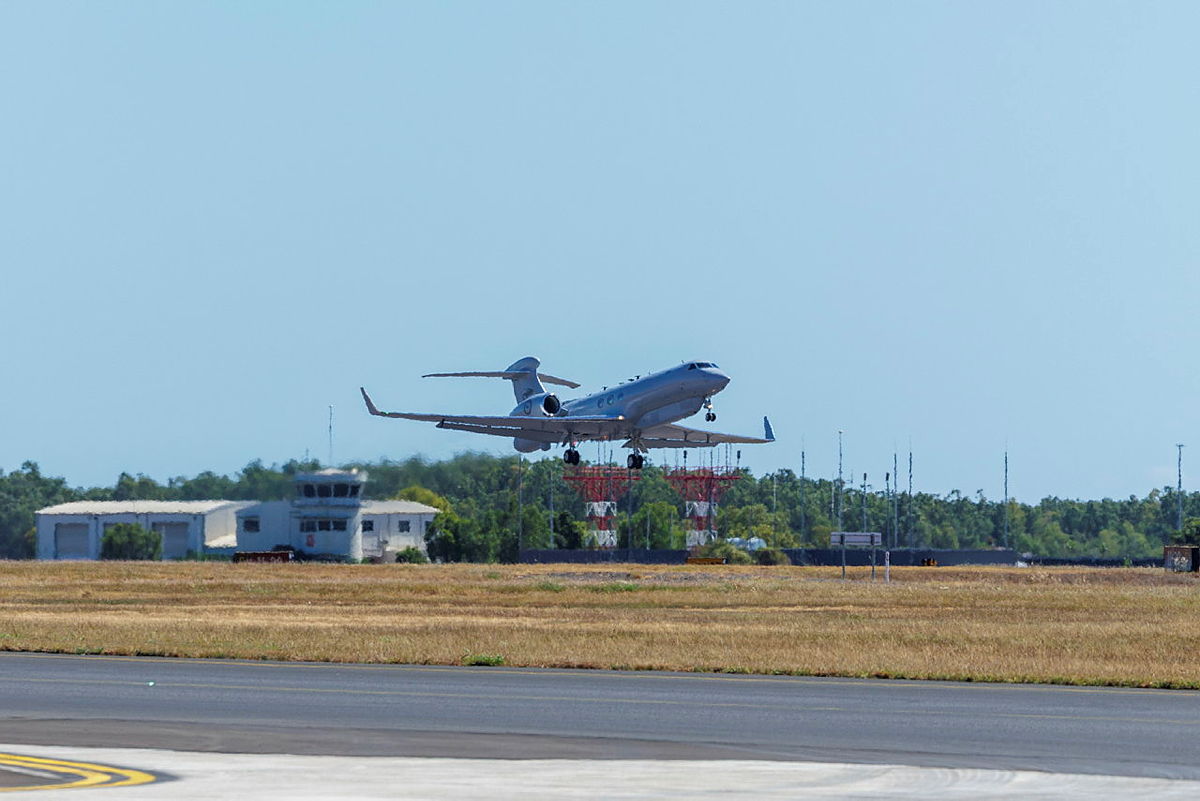
CAPTION: A Royal Australian Air Force 10 Squadron MC-55A Peregrine takes off for a sortie from RAAF Base Darwin. Photo by Flying Officer Nicolle Mistry.
.
.
EDITOR’S NOTE: CONTACT believes RAAF is deliberately dropping ‘Royal Australian’ from its name – despite Defence formally assuring us it isn’t true. Campaigning against this name-change-by-stealth, CONTACT has amended the above report appropriately. See here for the back story
.
.

.
.