1st Armoured Regiment: How long to reform?

Making 1 Armd Regt an experimentation unit has reduced the capacity of our Nation to defend itself. 3 Brigade in Townsville is supposed to be an armoured brigade, but it is forced to operate light by a tank squadron, a cavalry squadron and a battlegroup headquarters. This is a considerable reduction in its combat power.
Some deny this by alleging that there’s no longer any place for tanks on the battlefield, now that drones are ubiquitous. As is common in military affairs, however, whenever a weapon is designed, a counter to it, quickly follows. In the case of drones versus tanks, it is the Active Protection System (APS).
Although other nations have moved quickly to make use of APS, not so Australia. Why not? It’s simply an expense that can’t be afforded within the Defence budget, given the cost blow out associated with the AUKUS submarines. The cut back in the strength of 3 Brigade is also a consequence of cost saving, i.e. fewer units mean less manpower and lower operating costs.
But at what point does cost saving within the Department of Defence actually imperil the nation’s ability to defend itself?
As a consequence of 1 Armd Regt being made a non-combatant, 2 Cavalry Regiment (Townsville) has been forced to take on a dual role, with two squadrons of tanks and two of reconnaissance vehicles. Trouble is … these roles are incompatible for a single unit.

[Recon uses stealth (and, at times, speed) to gather intelligence about the enemy; tanks, on the other hand, seek to destroy the enemy using fire and manoeuvre.]
2 Cav Regt can manage to some degree during peacetime, but that’s its limit. In any operational context, separate tank and recon units are essential. The problem with a peacetime role of this nature, is that false lessons are continually being inculcated. This has a retrograde impact on the unit and lengthens the time for it to reach operational readiness.
Times needed for units to become ‘operationally ready’ are certainly not available publicly; and, for as much as anyone knows, might not even be available to commanders. How long will it take to reform 1 Armd Regt as a tank regiment and 2 Cav Regt as a recon regiment, and bring them up to operational readiness? This is a fundamental consideration in terms of Defence preparedness; one the Chief of Army dismisses.
The theory could be … at a time of operational emergency, reform 1 Armd Regt’s Regimental Headquarters and have it command the tank squadrons currently with 2 Cav Regt (while also forming a third squadron). Sounds simple, however, that’s where the problem lies. Unit identity is much more than just assembling numbers of tanks and crews. It involves esprit-de-corps; and forming bonds within and between crews … just as much as individual crew skills and tactical training.
Operational readiness for a tank regiment means being better than anyone else in bringing fire to bear, in advancing to contact, in initiating a quick attack, and keeping every callsign going; this, in turn, has to be a unit’s total focus and commitment.
How long this takes, depends without any doubt, on the leaders involved … from trooper to lieutenant colonel.
Lieutenant Colonel Bruce Cameron, MC, RAAC (Ret’d)
.
.
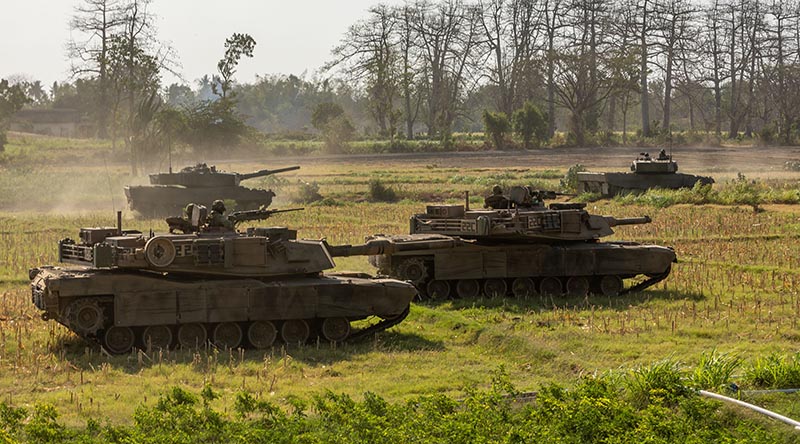
FILE PHOTO: Australian Army soldiers from the 1st Armoured Regiment conduct manoeuvre training on an M1A1 Abrams Main Battle Tank in Puslatpur, Indonesia during Exercise Super Garuda Shield 2023. Photo by Sergeant Jarrod McAneney.
.
.

.
.