Winning the next war – how do we do it?

“When you’re static, your intelligence, surveillance and reconnaissance drones find the enemy really easily. And if you can find the enemy easily, you can target them easily.”
Stripping the tanks from 1st Armoured Regiment was the worst start possible!
Moving on from there … feedback from the war in Ukraine, is that:
“Properly protected, integrated with drones and supported by electronic warfare, armour remains indispensable, particularly when taking ground.”
Where does Australia stand in terms of the above criteria: i.e. properly protected, integrated with drones, and supported by electronic warfare?

The Albanese Government has allocated up to $22 billion for drone, counter-drone and autonomous system technologies over the decade in the 2026 Integrated Investment Program.
Every expectation is that Australia recognises the threat and is well on the way to rising above it.
Importantly, an Australian Army Research Centre report: “Drones in Modern Warfare (2024-2026): Lessons Learnt from the War in Ukraine” makes the point that:
“In the eyes of the army, without the ability to hold ground, it does not matter how many drones you have, how far those drones can project or what kind of warhead they can employ. If no one is there to occupy the ground, eventually the battle—and subsequently the war—will still be lost.”
So … being able to occupy and secure territory remains, as always, the ultimate end-game.
This means, of course, that manoeuvre warfare continues to be the ‘secret’ to winning the next war.
Not that there was any doubt about this, but some writers have created a sense of drones being the solution to all future warfare needs, e.g. “The rise of cheap drones is reshaping global warfare, challenging traditional superpower dominance”.
Google explains manoeuvre warfare as a “military strategy that focuses on movement, surprise, and initiative to gain an advantage. Instead of using raw force in direct frontal fights, it targets an enemy’s weak points and breaks their will to fight”.
Good explanation, but isn’t this the secret of all successful battles … that and operations based around combined arms?
Drones have obviously changed the conduct of war. The challenge is to understand the nature of the change and use it to advantage.
The use of surprise must become the hallmark of the future.
As the saying goes … if you’re static, you can be targeted! Concealment techniques obviously become a priority, but ‘surprise’ is the real key!
Unfortunately, it’s very difficult to achieve. Ground-force mobility is obviously important. Surprise strategic strikes can be achieved with artillery, but the need to follow-up quickly and secure territory occupied, is crucial. Armoured forces are needed here.
If you are the Chief of Army, the last thing you would do, is strip tanks from 1 Armd Regt.
Lieutenant Colonel Bruce Cameron, MC, RAAC (Ret’d)
.
.
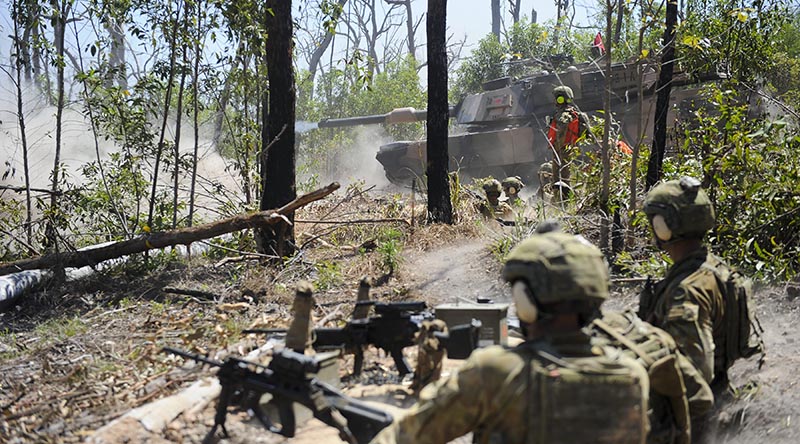
FILE PHOTO: Soldiers from 8th/9th Battalion, Royal Australian Regiment, watch on as an M1A1 Abrams main battle tank fires in support during Exercise Diamond Run 2017. Photo by Captain Anna-Lise Brink.
.
.

.
.