The unjust treatment of 1st Armoured Regiment: Who should apologise?
Share the post "The unjust treatment of 1st Armoured Regiment: Who should apologise?"

Before any apology, there must be an acceptance of responsibility. This, in turn, requires an understanding of the wrong-doing involved and the extent of the harm done. The following is an attempt to make sense of these things.
Status of Available Information
Letters giving ‘official’ information have been received from the Chief of the Defence Force (CDF) and the Minister for Defence. The contents of letters from the 1st Armoured Regiment Association and the response from the Chief of Staff, AHQ, are also a matter of record. Apart from the Defence Strategic Review (DSR) and the Government’s response, everything else referred to has been garnered from public media/news sources or is the result of personal deduction.
What Happened
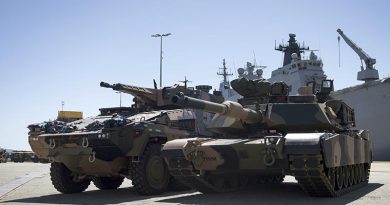
On 28 Sep 23, it was ‘announced’ in the Government’s response to the Defence Strategic Review (DSR), that 1st Armoured Regiment was to be stripped of its tanks and they were to be transferred (with a number of crews) to the 2nd Cavalry Regiment in Townsville. This was being done to enable a small non-combatant ‘emerging technologies’ unit to be created under command of 1 Armd Regt in Adelaide.

As far as it is known, the decision was not discussed publicly beforehand. Simply put … the RAAC, its stakeholders, and veterans, were ambushed. A unit which had spent 75 years learning to survive and win on the battlefield, day after day, was suddenly told that its tanks had been removed and it would no longer be a fighting arm of the Army. Surely, a unit with 1 Armd Regt’s record of service, deserves to end its combat days under better circumstances than this?
Of course, such decisions are never made in isolation. While consultation might have been limited, it undoubtedly occurred to some extent within the Defence hierarchy. There appears, however, to have been a deliberate decision to keep 1 Armd Regt’s future ‘under wraps’ until it was officially announced. Could there have been a concern that any advance publicity might create a backlash? Whatever the reasoning, it is interesting to note that an ethical process is an open and transparent one, not a secret one.
Past Commanding Officers (COs) were as much in the dark as everybody else. What a nice gesture it would have been for the RAAC Head of Corps (HOC) to have informed former 1 Armd Regt COs what was about to happen to the unit they had once commanded (then again maybe the HOC was also in the dark).
Three days before the announcement, a retired RAAC officer, Maj Gen Fergus McLachlan, AO, (a former CO himself), was quoted in ‘Contact’ magazine saying that 1 Armd Regt and 7RAR may be disbanded in the near future. The article stated that “both formations may be absorbed into others, because recruiting issues have left many formations ‘hollow’. For example, 7RAR may be re-linked to 5RAR, to re-form 5/7RAR; and 1 Armd Regt could be absorbed into the 2nd Cavalry Regiment in Townsville”. It was claimed that recruitment difficulties had left many units undermanned.
The ‘leak’ proved to be correct with respect to both units. General McLachlan’s personal comment was telling: “In a very small Army with a handful of battalions, I hope these rumours are not true. Perhaps a few less headquarters first?”
The Reason it Happened
Plan Beersheba was a turning point for the RAAC. Implemented during 2014-2017, it resulted in the RAAC’s three ARA units forming armoured cavalry regiments, each one comprising three squadrons (one tank, one cavalry, and one armoured mobility). In 2017, however, the infantry assumed responsibility for armoured mobility, i.e. Armoured Personnel Carriers (APCs) and their replacements, Mechanised Infantry Combat Vehicles (MICVs). This resulted in an increase in the infantry’s manpower entitlement, with an equivalent reduction in that of the RAAC (from nine squadrons to six). There was a period of change-over and RAAC units adjusted and managed (as they do).
In 2017, 1Armd Regt re-located from Darwin to Adelaide (2 Cav Regt had re-located from Darwin to Townsville in 2014). All three RAAC units, including 2/14 LHR (QMI) in Brisbane, retained their tank squadrons at this stage. On 27 Oct 22, 1 Armd Regt became part of 9 Brigade, the Army’s first integrated combat brigade (‘integrated’ in the sense of combined ARA and ARES). A Squadron, 3/9 SAMR, came under command of 1 Armd Regt.
Then came the DSR and the announcement that 1 Armd Regt was to become an experimentation unit.
An armoured brigade was to be located in Townsville and it was decided that 2 Cav Regt would command four squadrons (rather than the usual three), comprising two tank and two cavalry. An alternative would have been for 1 Armd Regt to command the tanks and 2 Cav Regt to command the cavalry; with 2/14 LHR (QMI) providing the experimentation unit. Disappointingly, however, the CA was unwilling to consider other options. As a result, 1 Armd Regt was effectively removed from the Order of Battle (OOB).
The Australian Defence Force (ADF) was having recruiting difficulties at the time (and still is). While these mainly affected the RAN, it was an advantage for Defence not to have to create a new unit from scratch.
How the Chief of Army (CA) became a convert to raising a unit to manage new and emerging technologies (as per examples in place with other Armies), is not known. It seems, however, that he (and/or his advisors) became quite fixated … striving to demonstrate that Army was keeping abreast of technological developments.
Indeed, it became clear that the CA wanted a unit which could ‘hit the ground running’ (so as to compensate for earlier procrastination). This was a priority, in his eyes. On a National Security Podcast on 7 Nov 24, he stated: “We just stood up, based on the 1st Armoured Regiment, a tech-scale battle group. That’s our way of fast-tracking the application of new and emerging technology and then exploiting it across the rest of the army”.
Interestingly, the former CDF made no mention of the manpower considerations referred to above, when he described why 1 Armd Regt had been selected. The reasons he gave were:
- “The Regiment’s reputation as some of the Army’s foremost experts in manoeuvre warfare”; and
- “The Regiment and its soldiers have the adaptability and tactical creativity needed to succeed in this task”.
The new experimentation unit would require a higher-level HQ to manage the complexity of its tasking. With this consideration in play, 1 Armd Regt became the ideal candidate. 2 Cav Regt was in already Townsville, which was where the DSR wanted Army’s armoured brigade to be located. The RAAC’s third ARA unit, 2/14 LHR (QMI), has close ties to Brisbane and Queensland and is fully integrated into the community there. Furthermore, Adelaide happened to be the location of a growing defence industrial base … all of which gelled neatly with 1 Armd Regt becoming the experimental unit. Nevertheless, one can’t help wondering what lobbying went on behind the scenes?
Theoretically, any one of the RAAC’s three ARA units could have been chosen; or indeed, any unit across the Army. Which begs the question, were any other units considered, or was 1 Armd Regt targeted specifically? The response given to the author when he asked a ‘one star’ officer if other units had been considered for the new role, was:
“Relating to other units considered. There were multiple courses of actions considered under a broader capability review. To single out this one component of the review would be unhelpful as they are inter-related across a large number of units and future capability needs”.
Maybe this means something to someone better versed in officialese. (A simple yes or no would have been preferable.)
It would seem that manpower constraints were not the driving factor in the decision to make 1 Armd Regt the new emerging technologies unit. The matter actually turned more on the fact that the CA (and presumably his key advisors) considered the need for such a unit to be a priority for Army. It seems likely that 1 Armd Regt was the obvious choice because of its location. 7RAR, also in Adelaide, could well have been another contender, however, planning was afoot for it to merge with 5RAR. If any store is to be placed on the CDF’s letter, it seems that 1 Armd Regt was considered best suited to the new role (though one has to wonder if moving 1 Armd Regt to Adelaide was part of a long-term plan on the part of Army).
How could this happen to the senior regiment of the senior Arms Corps of the Army, one commemorating the 75th year of its service … the Regiment which, until now, had occupied its place on The Right of the Line? There was a sense of shock and disbelief.
The 1 Armd Regt Association stated that it was “advised by several respected retired Armoured Corps Generals that the decision to re-role 1st Armoured Regiment, would surely be reviewed and that common sense would undoubtedly prevail. In the meantime, the Association and veterans of 1st Armoured Regiment, should try and remain calm rather than undertake a campaign of advocacy which could inflame a sensitive situation.”
Common sense did not prevail and senior RAAC officers subsequently made multiple representations to the CA to change his decision, allowing 1 Armd Regt to maintain its combat role. Supporting the need for Army to more fully embrace future technologies, as he did, the CA dismissed all appeals received from within the chain of command. Over a period of less than ten years, the unit had gone from being Army’s only tank regiment, to one of three armoured cavalry regiments, to complete removal from the OOB.
Note. The former CDF stated that the “Regiment’s position on the Army’s Order of Battle is unchanged”. This obviously can’t be true. OOB refers to deployment on the battlefield and level of combat effectiveness. A tank regiment which is stripped of its tanks to become a non-combatant, cannot maintain its place on the OOB.
The Consequences of What Happened
When the CDF stripped 1st Armoured Regiment of its tanks and made it a non-combatant, both he and the CA failed to realise that the unit could never be the same. They thought that it would continue on as it had in the past, just in a different role. But this isn’t possible. A regiment comprised of tank crews, tight knit as they always are, is different to any other sort of unit. The close-ties formed by the crews, and their resulting esprit-de-corps, is unique.
For some, the close ties that exist within a tank crew meant that it was like a small family. You all stick together and everyone does his bit for his little community. Trust was one of the key elements. You trust them and they trust you. Living, training, and fighting in the close confines of your steel monster creates a work place and a work ethic like no other. Operating ‘closed down’ for lengthy periods is part of the routine that goes with the job. Four men (and now, women too) grow into a tight cohesive group; becoming a living part of their armoured beast, knowing it and its idiosyncrasies inside out. Individual crew tasks must be perfectly timed and completed in unison, to operate the tank successfully.
After a while, it’s like you’ve all grown up together. You share everything; know each other’s lives and loves, hopes and dreams; know what pisses each of them off or makes them happy. The true meaning of brotherhood becomes a reality. To this end, everyone knows his job inside out … fail in your job and you fail your crew. Each of us had the lives of the others in his hands and he knew it. Our duty became that of caring for each other; we would do anything for one another.
A tank crew is a unique team, one with potentially the greatest diversity of rank in the Army. The driver may be a trooper and the commander any rank from corporal to lieutenant colonel. When fighting as a crew, rank is irrelevant and trust in each other and in each other’s skill is paramount. It’s not an uncommon thought for those reminiscing: “I miss my crew and nothing will make me forget them”.
The unit might take on a new role, but without tanks and those who crew them, it will be a completely different entity… this will always be so. When it lost its tanks, 1 Armd Regt also lost the traditions and heritage built up during its 75 years manning tanks. Without tanks and their crews, it’s quite impossible for a non-combatant unit to replicate them.
The fighting spirit and morale of a unit is something built up, year by year, throughout its existence. It is the sum of Battle Honours, reputation, traditions, and heritage. This is particularly so when a unit has established itself as the exemplar of manoeuvre warfare and shock action (which, paradoxically, were supposedly the factors which led to 1 Armd Regt being selected for its new role).
The first consequence is the loss of the heritage and tradition embodied as a tank regiment during its service to the nation; service which is no longer able to form a legacy of excellence in tank-craft and combat which can be passed on to those serving in the future. Veterans who served in Vietnam, contributing to the unit’s three battle honours and Unit Citation for Gallantry, find this particularly galling.
It is a consequence which carries with it hurt and pain, as expressed well by the 1 Armd Regt Assn: “The pain that Army’s decision has caused the 1st Armoured Regiment veterans, particularly those who served in combat in South Vietnam, cannot be understated. To be frank they all feel gutted as they watch the Regiment stripped of its soldiers, tanks and armoured warfighting capability. They see the demise of the Regiment’s esprit-de-corps that they feel they spilt blood to create. The veterans believe the Army’s decision is the ultimate betrayal of their service. They are gutted as they watch all that 1st Armoured Regiment has been during its 75-year history … trashed.”
Another consequence is well summed up by Wikipedia: “The removal of 1st Armoured Regiment as a combat unit, the RAAC’s oldest regular unit and one of its most decorated, effectively reduces the number of active combat Armour units in the Army to two; the 2nd Cavalry Regiment in Townsville and 2nd/14th Light Horse Regiment in Brisbane”.
The second consequence is that Army has relinquished a major element of its combat power; while also imposing constraints on 3 Brigade’s armoured brigade in Townsville. With the loss of 1 Armd Regt from the order of battle, Army sacrifices the combat power of a battle-group headquarters, as well as that of both a tank and a cavalry squadron. (Not only is the capability lost, but so too is the lengthy training time necessary to regain the skill levels in the future.) There is no recompense for a tank squadron being wiped from the ORBAT.
It’s to be expected that the CA wouldn’t have voluntarily agreed to this loss of combat power … yet it seems that he did exactly that. Apart from the recruiting shortfall, something else outside his control is Army’s inability to support tanks based across dispersed locations. The armoured cavalry regiment ‘experiment’ proved that there simply weren’t enough tanks to enable serviceability levels to be adequately maintained across three different locations. Army subsequently acquired 75 new M1A2SEPv3, compared to the earlier fleet of 59 M1A1s, however, this is still insufficient for serviceability purposes.
A position recognising the loss of combat power, was adopted by the 2024 RAAC Corps Conference (involving commanding officers and honorary colonels from all units). It was agreed that:
- “The creation of an Experimental Unit in Army is sensible and useful, but it has no relationship with 1 Armd Regt.
- The best operational outcome for Army is to form two battlegroups in Townsville, one commanding the cavalry and one commanding the tanks.
- The best way to achieve this outcome is to raise RHQ 1 Armd Regt in Townsville and to assign the tanks to it”.
At present 2nd Cavalry Regiment in Townsville is an incompatible dual-role unit (tanks and reconnaissance), commanding four squadrons (usually a regimental headquarters only commands three). It could be argued that 2 Cav Regt has become a beneficiary of the new set up (indeed, the CO has presented a case to this end).
The advantage to be gained by 1 Armd Regt taking command of the two tank squadrons, is that it would enable 3 Brigade to form an additional battlegroup (adding considerably to the formation’s flexibility and combat power).
The former CA had many powers, but what he’s never had the right to do is to is diminish the heritage and traditions built up by a unit during service to the nation on the Government’s behalf. By doing this, the Army community at large is both hurt and disrespected.
Who’s Responsible?
The former CA is undoubtedly the person responsible; but does he understand the depth of the hurt that’s being felt by veterans? Maybe he does, and it has no significance for him; in which case there is nothing further to be done. On the other hand, maybe he has no idea about the distress his decision has caused. This would be surprising, given the correspondence with the CDF and Minister for Defence, as well as with the CA’s Chief of Staff at AHQ.
I wrote to the former CA on 10 Feb 25, finishing on this note:
“The 1st Armoured Regiment badge was designed to acknowledge the unit’s role in operating tanks to close with and engage the enemy. Why should it continue to be worn by a unit that has no association whatsoever with tanks, let alone a combat role? The same can be asked about the RAAC’s distinctive black beret. If it was the intention of Defence to completely wipe a unit’s reputation from the ADF ledger, this has been successfully achieved.
General, you have it in your hands to either completely destroy a once proud Army unit or to raise 1st Armoured Regiment HQ in Townsville and have it command the two tank squadrons. “
I haven’t had a response … and now, after so long, I don’t expect one.
Who Should Apologise?
As the one responsible, the former CA is obviously the one who should apologise. If he isn’t moved by a campaign that’s involved over 100 published letters, however, it’s unlikely that he will ever acknowledge the extent of the suffering caused. Should anyone apologise on his behalf?
The RAAC Representative Honorary Colonel is the RAAC’s senior officer. It’s been made clear, however, that any public criticism of a position adopted by Army … is called insubordination.
Which leaves us exactly … where?
Sadly, in the same place we started; looking for a leader; someone with authority who is prepared to take a stand on behalf of 1 Armd Regt and its heritage.
Lieutenant Colonel Bruce Cameron, MC, RAAC (Ret’d)
.
.
ChatGPT image
.
.

.
.