New roles defined for RAAC tank and cavalry units!
Share the post "New roles defined for RAAC tank and cavalry units!"

The Royal Australian Armoured Corps (RAAC) used to have three roles. With armoured mobility having been taken over by infantry, however, there are now only two: the provision of close fire support for infantry; and, reconnaissance.
Australian Army doctrine describes the role of an armoured (i.e. tank) regiment as being — in coordination with infantry, artillery, attack aviation, and engineers – to close with and destroy an enemy using fire, manoeuvre, and shock action.
According to the same doctrine, the role of a cavalry regiment is to locate, dislocate and disrupt an enemy through the conduct of offensive, defensive, reconnaissance and security activities, both mounted and dismounted.
It used to be that RAAC regiments were homogeneous units. With 1st Armoured Regiment being made an experimentation unit, however, a dual role-unit has been created for the first time. The 2nd Cavalry Regiment has been forced to take responsibility for both closing with and destroying an enemy; as well as conducting reconnaissance and gathering intelligence (among other tasks).
Is it possible for a single unit to do both?

Absolutely not!
[Note: it’s interesting that Army doctrine today states ‘an enemy’; manuals used to state ‘the enemy’. Is there a suggestion here of having to be prepared to confront more than a single enemy?]
Former Chief of Army Lieutenant General Simon Stuart has certainly left behind an immense ‘legacy’ (if that’s the right word) as far as the RAAC is concerned.
Of course, it’s possible that the incoming Chief will reinstate 1 Armd Regt to its rightful place as 3 Brigade’s tank regiment. But what happens if she doesn’t and 2 Cav Regt has to maintain the current folly?
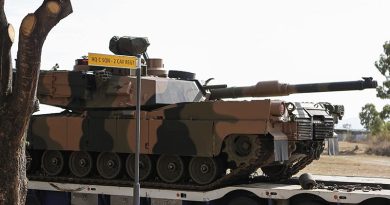
Close fire support for infantry is provided by tanks. Being specifically designed for the task, these AFVs are ideally suited to it. They have the ability to break down close country and directly attack fortified enemy positions. They can also use their speed and mobility to rout an enemy with shock action.
Intelligence gathering with reconnaissance vehicles, on the other hand, frequently requires stealth, i.e. closing with the enemy, while avoiding detection. Something completely at odds with providing close fire support.
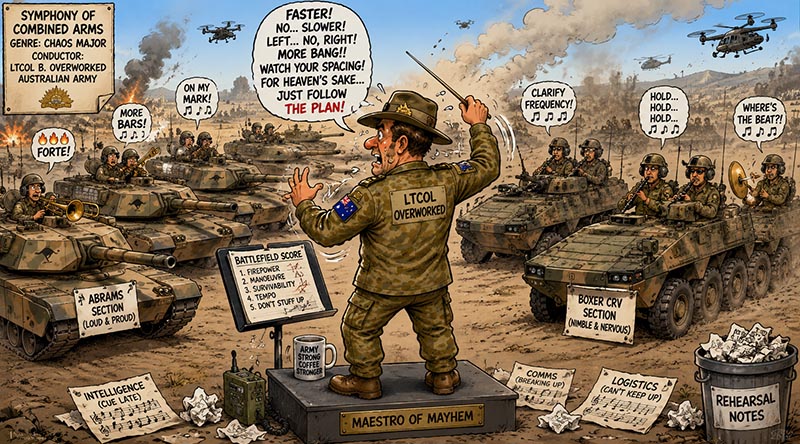
The two roles are so totally different, how does a commander bring them together?
Does he try … or does he maintain separation between the two halves of his command?
The differing skill sets for tank and recon both require constant honing to reach combat readiness. It would seem that the only way to achieve this, is to split the unit and conduct training separately for tanks and recon.
With four squadrons (rather than three), one would expect that the 2 Cav Regt echelon would be supplemented. Resupply needs for tanks, of course, are completely different to those for recon vehicles. So, a supplemented AND a tailored echelon.
This raises the issue of command. Ideally, an additional major would be made available to command the tank squadrons; while the regimental 2IC looks after the cavalry. This would allow the CO to meet his command obligations.
Unfortunately, this is unlikely to happen (as is supplementation of the echelon)!
Lieutenant Colonel Bruce Cameron, MC, RAAC (Ret’d)
.
.
ChatGPT image
.
.

.
.