
Introducing Australia’s ‘tactical dream team’
Share the post "Introducing Australia’s ‘tactical dream team’"

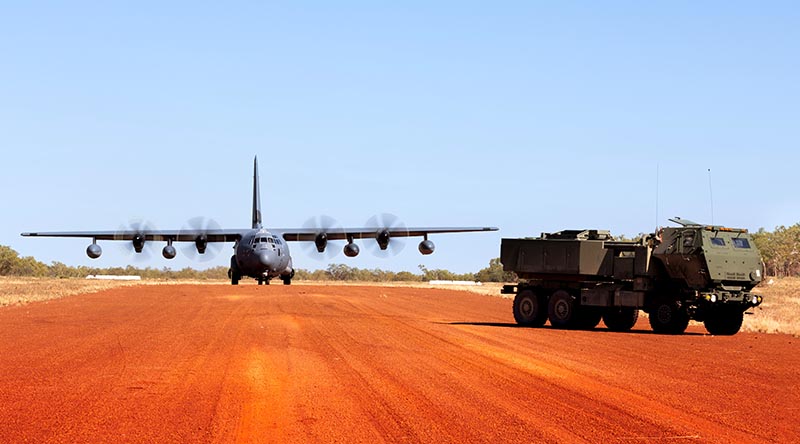
C‑130J ‘Super Hercules’ is the workhorse of the sky and, matched with the ADF’s growing fleet of HIMARS launchers, forms a ‘tactical dream team’ that will give the ADF an edge in contested environments.
FILE PHOTO: A USAF MC-130J prepares for takeoff after delivering a HIMARS unit to Delamere Air Weapons Range, Northern Territory, during Exercise Talisman Sabre 2023. Photo by Leading Seaman Susan Mossop. Story supplied by Lockheed Martin Australia, edited by CONTACT.
The tactical airlifter and the wheeled rocket launcher’s combined capabilities are transforming how Australia thinks about deep fires and battlefield mobility.
Together, the C‑130J and HIMARS form a high-impact, quick-response strike capability that offers the Australian Army a rare mix of agility and firepower.
Australia first procured 12 C‑130Js in 1995 and has operated the type since 1999.

Under the 2026 National Defence Strategy, Australia will replace these airframes and increase the fleet to 20.
The Australian Government has also committed to HIMARS with 42 launchers for the 14th Regiment, Royal Australian Artillery of the Australian Army’s 10th Brigade.
HIMARS launcher has an outstanding record of combat-proven reliability, enables multi-domain operations, improves response times and meets mission-critical needs with leap-ahead technology.
Critically, HIMARS is a flexible system that can transition between surface-to-surface fires and land-based maritime strike mission in mere minutes.
HIMARS launchers can fire a suite of munitions including Guided Multiple Launch Rocket Systems (GMLRS), Extended-Range GMLRS and Precision Strike Missile (PrSM).
A Second Long-Range Fires Regiment (2LR) has already been announced, primarily using HIMARS and PrSM.
This HIMARS-PrSM combination, especially in tandem with the C-130J Hercules, will provide an unmatched anti-access and sea-denial capability for the Australian Army.
C-130J Hercules is capable of landing on austere, short runways and quickly unloading or loading cargo under pressure—the ideal capability for Australia’s rugged northern approaches.
HIMARS is a precision-guided rocket artillery system that can deliver devastating firepower at targets up to 500km away.
Speed, surprise and survivability are what can make the two partners so effective when working in tandem.
C-130J can insert the rocket system into forward locations, even in denied or contested airspace, execute a rapid offload.
HIMARS can then rapidly ‘shoot and scoot’ to fire on strategic targets such as command nodes, supply hubs, air defences or even ships at sea, before the enemy can respond.
In some cases, the C-130J doesn’t even shut down on the ground during offload – performing a combat offload, rapidly offloading the HIMARS as it rolls to a stop – ahead of a quick departure.
This manoeuvre, known informally as a HIMARS rapid infiltration, has evolved into a signature tactic, giving ground forces long-range strike options without the need for a fixed, vulnerable base.
The C-130J and HIMARS combination has been successfully tested in a number of multinational exercises, including Talisman Sabre 2023 and 2025, Exercise Highball 2023, and Exercise Kenney Strikes Back in 2026.
In the Indo-Pacific region, where infrastructure is limited and there are multiple strategic chokepoints, the C-130J and HIMARS combo offers a low-profile, high-lethality presence.
It’s a particularly valuable tactic in Australia’s near-region, where the vast geography and dispersed nature of potential conflict zones demand mobile, self-contained strike packages.
As new variants of long-range precision fires are integrated into HIMARS – including hypersonic capabilities – and as C-130J upgrades improve range and survivability, this key ‘tactical dream team’ is likely to grow even more lethal.
.
.

.
.


