Close fire support for infantry: A thing of the past?
Share the post "Close fire support for infantry: A thing of the past?"

“Our attack was timed to start at 12.30am on 23 July 1916. Three shrill blasts on a whistle, was the signal for us to hop out. How those minutes dragged! At long last, above the frightful din the three whistle blasts were heard. Over the top and the best of luck.”
It used to be that infantry would be ordered to ‘go over the top’ … meaning that they would have to get out of their trench and attack the enemy (often directly into the fire of machine guns).
Their bravery was immense! Orders were always obeyed, even though they all knew there was every chance they would be killed. The book ‘Over the Top’ records that “The [Australian] 2nd Battation mustered 985 men in its ranks on 19 July [1916] to go into the line at Pozieres; but, when it was relieved by the 8th Battalion on 26 July, only 125 of them answered the battalion roll call …”.
Something had to be done to stop the carnage; so, it was that the tank was born.
Tanks first went into action in September 1916; but it was the Battle of Cambrai in November 1917, which really changed the odds. They were used ‘en masse’ for the first time (378 fighting tanks). Although they ripped through the German defences (taking 7500 prisoners), bad weather intervened and the breakthrough could not be exploited.

Nevertheless, the ability of tanks to break the stalemate that trench warfare had degenerated into, had been demonstrated. War would be different henceforth, with manoeuvre warfare soon being heralded in.
The firepower, protection, and mobility of tanks would enable them to dominate the battlefield. No longer would infantry have to ‘go over the top’, without close fire support.
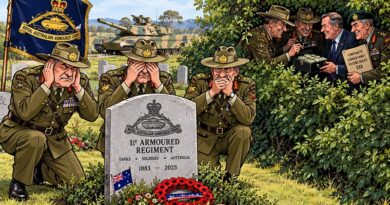
BUT wait! Tanks have been stripped from 1st Armoured Regiment … why? So as to make it a non-combatant experimentation unit. What about close fire support for infantry?
Don’t worry, 2nd Cavalry Regiment has been given four squadrons, two of them being tanks.
But wait a minute! That means that 3 Brigade (Australia’s only armoured brigade) is still short a battle-group headquarters, as well as a tank squadron and a cavalry squadron.
This, at a time considered by the Australian Strategic Policy Institute (ASPI), “as the most challenging security environment since World War II, requiring an acceleration of defence capabilities”.
How can this happen? Have infantry been classed as expendable once more?
Fighting to capture ground, has always been the same: infantry take the casualties. If tanks are available, there are many fewer casualties. There is no doubt: tanks save lives.
Why wouldn’t tanks be available … given their importance on the battlefield?
Because the Chief of Army has allocated other priorities.
But everyone knows that fewer tanks mean more casualties! Rightly so … but the CA has decreed he has other priorities.
Doesn’t anyone understand?
To convert a tank regiment to an experimentation unit, means a loss of expertise which is impossible to replace. The crew skills which are lost, are those buried in the very DNA of the unit.
Reaching combat readiness for a tank crew is the culmination of a journey which is years in the making. The word ‘crew’ goes part-way towards explaining this. Teamwork in the close confines of a tank is everything … anticipating what has to be done and doing it together. Crew needs always come first and selflessness is everything.
The CA has made 2 Cav Regt a dual-role unit: tanks for close fire support for infantry; and reconnaissance vehicles for intelligence gathering. As can be readily appreciated, these two roles are totally incompatible. Reconnaissance needs could very easily see 2 Cav Regt committed to a totally different part of the Combat Zone; unable to provide fire support when and where it is needed.
A tank regiment on the other hand, is a homogeneous entity; one whose self-worth is entirely predicated on the close bonds that exist between its crews. Its sole purpose is to provide close fire support for infantry (or engage other tanks).
Over the top … once more!
Lieutenant Colonel Bruce Cameron, MC, RAAC (Ret’d)
.
.
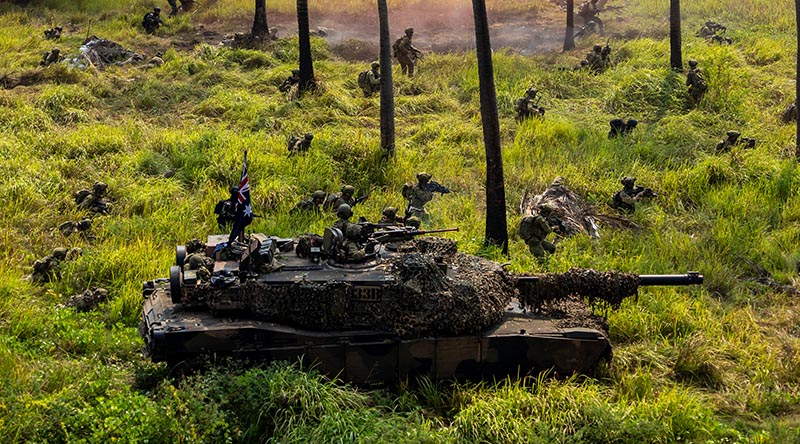
FILE PHOTO: Australian Army M1A1 Abrams tank and Australian Army personnel from the Amphibious Force, plus Indonesian National Armed Forces marines move inland from Banongan Beach, East Java, during Exercise Keris Woomera 2024. Photo by Andrew Green.
.
.

.
.