
RNZN USVs complete major patrol missions

The Royal New Zealand Navy’s two uncrewed surface vessels (USVs) recently completed the second of two border-security operations for Customs, monitoring marine traffic in Northland.
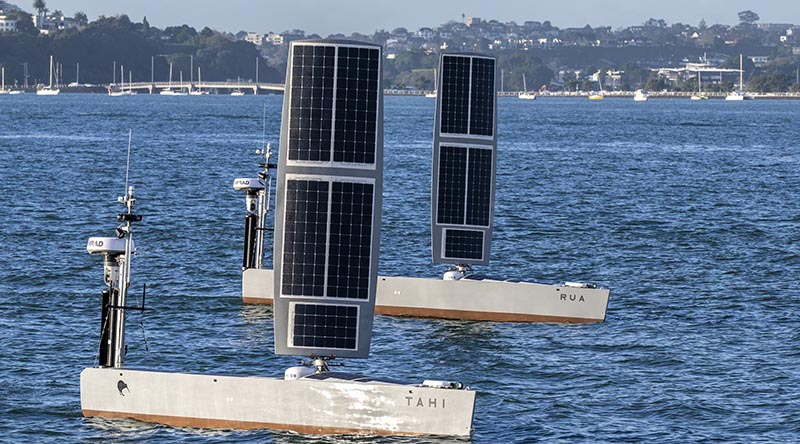
FILE PHOTO: Uncrewed Surface Vessels Tahi and Rua in the Hauraki Gulf during sea trials. RNZN photo.
The two 7.4-metre USVs, which use solar, wind or wave motion to power their monitoring systems and propulsion, undertook two sustained maritime patrols across east and west coasts, all under remote control from an operations room at the Devonport Naval Base.
Named Tahi and Rua, the USVs are a joint acquisition between RNZN and Customs, entering service last year.
Using radar, electro-optic and infrared cameras, the USVs were able to patrol up the east coast of Northland, including the Bay of Islands and Whangaroa Harbour, reaching as far as Ninety Mile Beach.

Their job was to monitor maritime traffic during the January to May season of small craft travelling to and from other countries, looking for vessels exhibiting behaviours of interest that could indicate narcotics transportation, such as transfers between ships or direct landings in remote bays and beaches under cover of darkness.
Data and imagery gathered during the patrols was passed to Customs for assessment.
The RNZN Officer in Charge of the operation Lieutenant Commander Sam Kinghorn, said the patrols provided persistent intelligence, surveillance and reconnaissance in areas difficult to monitor using crewed vessels.
“This deployment demonstrated that uncrewed systems can deliver significant operational benefit at very low cost.
“Benefits included real-time sharing of imagery and data with Customs, allowing them to assess and prioritise taskings.
“By reducing the need to deploy crewed vessels, the USVs improved force readiness, lowered risk to personnel, and potentially allow Customs boarding teams to be held at readiness if required,” Lieutenant Commander Kinghorn said.
Customs Maritime Manager Robert Smith said the joint acquisition of Tahi and Rua with RNZN provided a shared capability that directly supported Customs’ border operations.
“It allows Customs to access sustained maritime monitoring without relying solely on crewed assets, improving coverage in hard-to-reach areas and increasing the efficiency of our operations.”
Customs Group Manager Maritime Paul Campbell said the capability reflected the strength of a long-standing partnership with RNZN.
“Shared technology and intelligence allow us to operate more effectively together at sea,” he said.
“By aligning our efforts, we’re able to extend maritime awareness, respond faster to emerging risks, and target activity where it matters most.
“It’s a practical example of how coordinated, multi-agency operations strengthen New Zealand’s border.”
.
.

.
.


