
New ADF leaders announced

The Australian government today announced a number of senior command changes within the Australian Defence Force.
Subject to the Governor General’s consideration and approval, these changes will take effect from July 2026.
- Chief of the Navy Vice Admiral Mark Hammond will be appointed as the new Chief of the Defence Force.
- Rear Admiral Matthew Buckley will be appointed on promotion as the new Chief of Navy.
- Chief of Joint Capabilities Lieutenant General Susan Coyle will be appointed as the new Chief of Army – the first woman to reach chief of any Australian military branch.
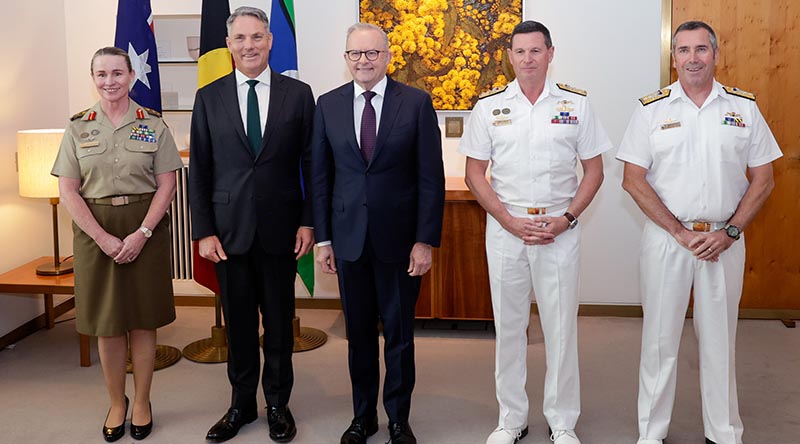
CAPTION: Chief prof Army nominee Lieutenant General Susan Coyle, Defence Minister Richard Marles, Prime Minister Anthony Albanese, Chief of Defence Force nominee Admiral Mark Hammond and Chief of Navy nominee Rear Admiral Mathew Buckley, after the change of leadership announcement in Canberra. Photo by Rodney Braithwaite.
Vice Admiral Hammond has had a distinguished career, spanning 40 years, in the Royal Australian Navy serving in frigates, and extensively in and later commanding submarines and the Australian Fleet.
Appointed the Chief of Navy in 2022, Vice Admiral Hammond will continue to bring valuable insight to the role of the Chief of the Defence Force – including towards Australia’s acquisition of conventionally armed, nuclear powered submarines through AUKUS, and the delivery of Navy’s future surface combatant fleet.

The government extended its deepest gratitude and thanks to the current Chief of the Defence Force Admiral David Johnston, who will retire with the change in command in July.
Admiral Johnston has served in the ADF for more than 48 years, in both Navy and joint appointments.
As the Vice Chief of the Defence Force, he was instrumental to the design of Australia’s future force and the subsequent ADF implementation of the 2024 National Defence Strategy.
Admiral Johnston has also provided long-term leadership to ADF operations as the Chief of Joint Operations and as the Chief of Defence Force.
He is the longest-serving ADF officer at the three- and four-star ranks, and the government congratulated him, and his family, for this tremendous achievement.
Enlisting as a soldier in the Army Reserves in 1987, Lieutenant General Coyle has worked at the tactical, operational and strategic levels and in command roles, including Head Information Warfare, Commander Forces Command, Commander Joint Task Force 633, Commander 6th Brigade, Commander Task Group Afghanistan and Commanding Officer 17th Signal Regiment.
Prime Minister Anthony Albanese said the government extended its sincere appreciation to the retiring Chief of Army Lieutenant General Simon Stuart.
“Lieutenant General Stuart has served with great distinction and leadership across the Army – most notably as the first Chief of Army to begin his career as a soldier, the PM said.
“Lieutenant General Stuart has been key to preparing the Army for the changes required to the force following the 2024 National Defence Strategy.”
Rear Admiral Buckley has served in Oberon- and Collins-class submarines, including commanding HMAS Collins and commanding the Submarine Force.
He was the Head of Nuclear Submarine Capability at the Australian Submarine Agency, before becoming Deputy Chief of Navy in January 2025.
This experience places Rear Admiral Buckley in a unique position to lead the Royal Australian Navy and its people over the coming years as it continues its vital contributions to the peace, safety and stability of the Indo Pacific region.
.
.

.
.


Hi Brian,
I’ve just been reading your post on the ADF change of command. It seems interesting that 2 paragraphs were devoted to Vice Admiral Hammond’s background and experience, his predecessor provided 5 paragraphs of highlights and achievements. 1 paragraph was provided outlining Lt Gen Coyle’s background and experience and her predecessor 3 paragraphs and 3 paragraphs devote to Rear Admiral Buckley’s background and experience.
Are we to make anything of this?
Hi Sharron,
The outgoing leaders get a bigger ‘send-off’ because they’ve ostensibly done a good job in the leadership role, while the incoming has yet to prove themselves.
That’d be my best guess.
Brian