
Does Australia still need an armoured regiment?
Share the post "Does Australia still need an armoured regiment?"

The nature of warfare changes constantly. Ubiquitous drones now make it very difficult to conceal an MBT from above. Improvements in concealment, by day and night, have become a critical priority for all Armies. So too, has anti-drone defence capability.
How we respond to this challenge says more about us as an Army, than anything else. Do we, for example, strip tanks from 1st Armoured Regiment on the basis that the ‘tank is dead’ (or might be very soon)? Or do we invest in technology which maintains and strengthens our tank capability?
Of course, if we need to fund any sort of technological development, this might not be possible because of the ever-increasing cost of the AUKUS submarine project.
How much do we value our tank capability? Is it just a ‘nice to have’ or is it essential? Given that a tank squadron has already been mothballed, it would be hard to justify the capability, as ‘essential’ in the eyes of the current defence hierarchy.
Does recruitment shortfall play a part here? Could it be that there are insufficient recruits with the right attributes to become tank crew? Should this be the case, maybe the 2 Cavalry Regiment four squadron set-up, is the ultimate compromise.

Which brings us back to the relative importance of a tank regiment. If it was an essential capability, recruitment efforts could be prioritised. But they haven’t been. Quite the opposite, it would seem.
Who’s behind the wheel? Who is it that’s making the decisions about priority, and for what reasons? Why aren’t openness and transparency the catchwords of defence decision making any more?
It must be asked why, what has traditionally been the core of the Army’s combined-arms fighting system, is no longer sufficiently important to warrant regimental status in its own right? Have all defence readiness needs been made subservient to the need to pay for AUKUS?
What voice do citizens have, who wish to discuss and better understand our defence preparedness and needs? NONE!
So, what do we do about it? There are some who’ll say that you’d have more hope pissing into the wind. As one who has written to the Governor General as the Commander-in-Chief of the ADF to protest at stripping the tanks from 1 Armd Regt, I’d have to agree. The GG declined the courtesy of a reply.
But this is in keeping with the Petition to Parliament asking for 1 Armd Regt to be returned to its combat role. With over 100 signatures more than the 50 needed to ensure a response from the Minister, we waited … and waited. Finally, we acknowledged that we weren’t getting a response.
Despite parliamentary protocols (which one might have expected to have been legislatively based) Ministers still do whatever they want (and citizens are left where they’ve always been, without any rights). Maybe this is a bit harsh, we really ARE a lucky country … but, even so, it’s still those in power who have the say (as always).
This, of course, doesn’t answer the question … armoured regiment or not?
There is no doubt that infantry need direct fire support … they always have and always will. The tank is the core of the Army’s combined-arms fighting system for very good reasons. These are valid today, just as they were yesterday.
A tank regiment forms bonds within crews which make it a unique entity; one which needs its own regimental identity to truly flourish. It cannot, for example, be combined with a cavalry regiment and be expected to succeed.
Lieutenant Colonel Bruce Cameron, MC, RAAC (Ret’d)
.
.
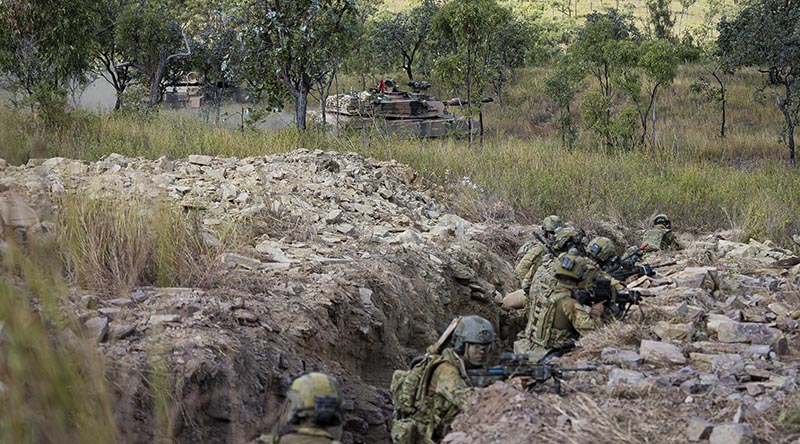
FILE PHOTO (June 2025): Australian Army soldiers from the 1st Battalion, Royal Australian Regiment, conduct a trench clearance supported by Abrams main battle tanks from 2nd Cavalry Regiment, as part of Exercise Brolga Sprint at Townsville Field Training Area, Queensland. Photo by Private Jessica Gray.
.
.

.
.


Hi Jack,
Thing is … infantry are left without close fire support (the reason that tanks were invented).
I wonder how many will volunteer to go forward to capture ground when faced by enemy machine-guns?
Best wishes, Bruce
Methinks Armour, RAAC, is going through same process, that was forced on Arty, RAA some time back.
That result less Arty Regiments, new system called, combined fires and other woke managerial stuff alluded to by Deputy Chief of Army.
Coincidental that this has happened to 1st and 2nd Right of the Line Corps, both with very long histories, traditions and battle honours.
Think about it.
Jack