
Love, loss and loyal service

In 1943, country girl Merle Hare was relishing her swish role in the salaries office at the prestigious Myer Emporium in Melbourne’s CBD, including weekly chauffeured trips in a Chevrolet limousine to hand deliver staff their pay packets.
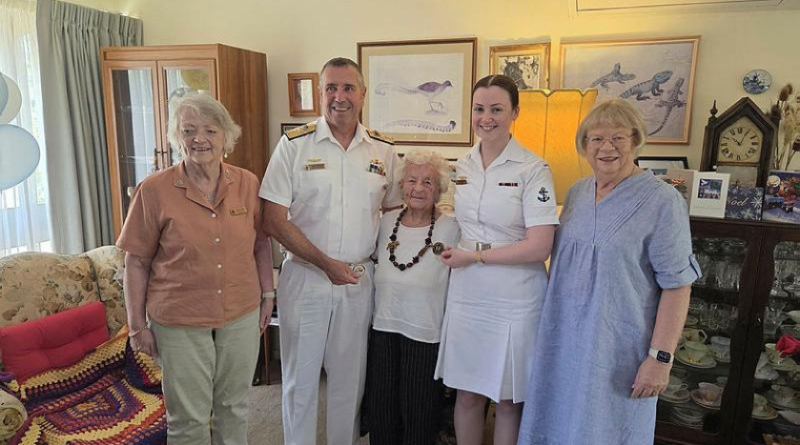
CAPTION: Deputy Chief of Navy Rear Admiral Matt Buckley and Leading Seaman Elodie Miles visit former WRANS writer Merle Hare, centre, for her 106th birthday, with, former Leading Navy Radar Plotter Pauline Gribble, far left, and former Navy member Judith Rowe. Story by Lieutenant Felicity de Fombelle.
Until the Royal Australian Navy (RAN) called.
The Japanese threat was real and RAN needed women for the Women’s Royal Australian Naval Service (WRANS), so men could be deployed to sea.
With twin brother Donald in the Royal Australian Air Force (RAAF), and older sister Alva in the Australian Army Nursing Service, the 4ft 10inch (1.47m) powerhouse didn’t flinch, swapping smart frocks and city life for a Navy uniform, marching drills and newly built wooden huts at Flinders Naval Depot.

Today, 83 years later, the sprightly 106-year-old speaks matter-of-factly about her naval career.
“The Navy needed ladies and in about five minutes I was gone,” Mrs Hare said.
“The war was coming to Australia and we had big problems.
I did everything I possibly could to help. Everyone did.”
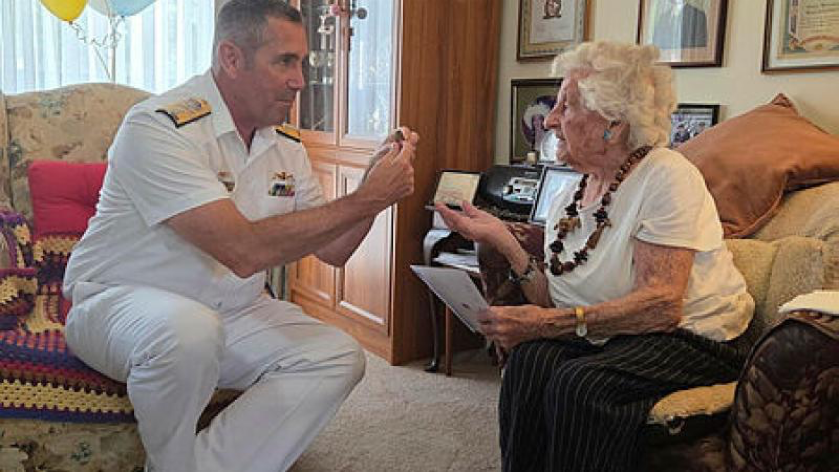
CAPTION: Deputy Chief of Navy Rear Admiral Matt Buckley visits former WRANS writer Merle Hare at her Canberra home for her 106th birthday.
Perched on an armchair in the small villa unit in Canberra she has called home for 25 years, the diminutive figure said she was proud to be a WRANS writer, with the important job of costing and ordering food supplies.
Accommodation was huts with six-bed cubicles, ‘wakey wakey’ was at 0600 and a duty officer would inspect each bed and kit at 1900.
But life wasn’t all work, with a Saturday night dance in the local town of Crib Point a highlight for enthusiastic naval and RAAF personnel.
Having been promoted to a leading WRANS writer in October 1943, it was Mrs Hare’s job to supervise the ‘Wrannery’ girls at the dance.
“Imagine this, little me with the job of marching the girls to the dance and back,” Mrs Hare said.
“Once or twice, a couple of the girls were sneaking around in the dark and getting up to mischief with the boys.”
Being given leave to be a bridesmaid at her brother’s wedding in Wagga Wagga was a rare privilege.
“Initially, my supervisor ripped up my leave request and said, ‘Don’t you know there’s a war on?’” she said.
“I stood to attention and said, ‘Ma’am, I wouldn’t be here if there wasn’t a war on’.
“I then told my chief petty officer what had happened and he marched out and made sure I got leave.”
The following year, it was her brother’s turn to attend her wedding, to Victorian Robert Hare, a gunner with the Australian Imperial Force 9th Division, who had served at El Alamein and New Guinea.
Tragically, that was the last time Mrs Hare saw her cherished twin, whose Catalina flying boat went down on a mine-dropping mission near the Philippines on March 7, 1945.
“It’s the worst thing that has happened in my life,” she said.
“They called me into the main office at Cerberus and told me Don and his crew were missing, perhaps shot down. It was a terrible shock.”
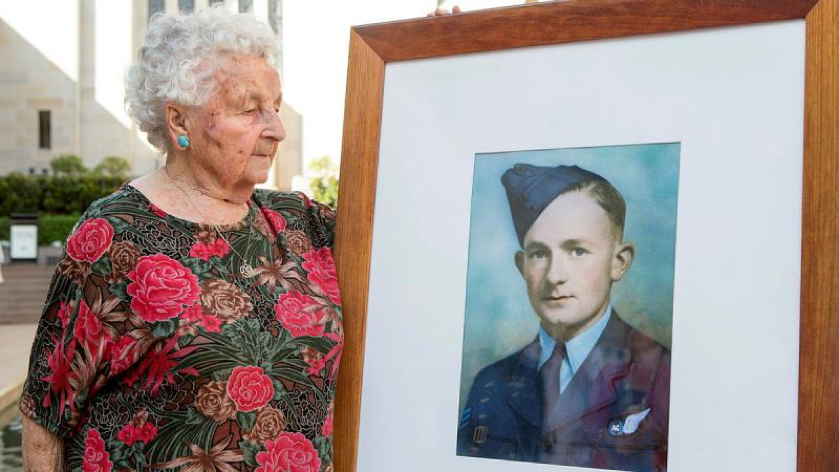
CAPTION: Merle Hare pauses to reflect at the Australian War Memorial in Canberra in 2020, after laying a wreath for her twin brother, Sergeant Donald Kelway Storrie, presumed killed in action 75 years ago. Photo by Leading Seaman James McDougall.
At the end of the war, Mrs Hare, husband Bob and sister Alva joined the celebrations in Martin Place, Sydney, but the pain of her brother’s loss has never left her.
She named her son Donald in his honour and had a daughter Ann.
Today, life is rich and full for Mrs Hare, with a steady stream of family, friends and WRANS for company and outings.
“I never stop,” she said.
“Whether I’m old or not, that doesn’t worry me.
I just take it one day at a time.”
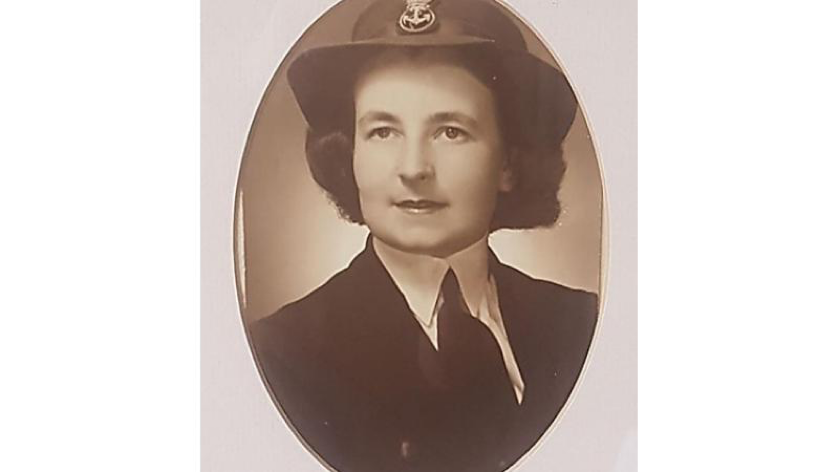
CAPTION: Then WRANS Writer Merle Storrie in 1944.
.
.

.
.


