
Wreck of first Australian-built war ship found
Share the post "Wreck of first Australian-built war ship found"

The wreck of Australia’s first Australian-built warship, Ex-HMCS (Her Majesty’s Colonial Ship) Spitfire, has been discovered 128 years to the day after it sank off the Queensland coast.
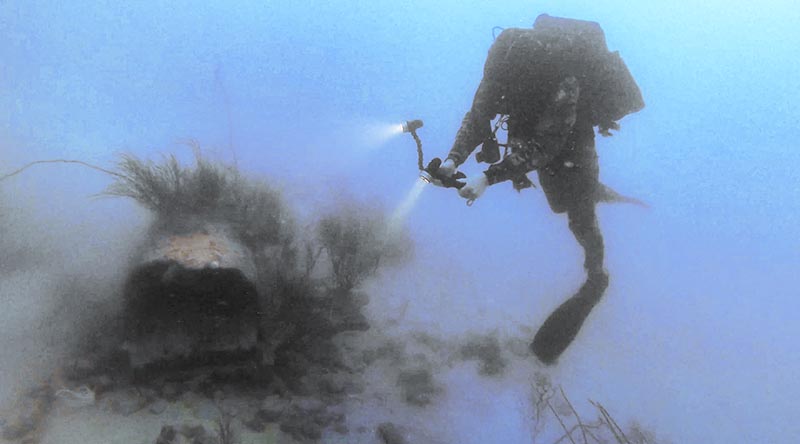
CAPTION: Ex-HMCS Spitfire wreck off the coast of far-north Queensland. Image supplied.
On 21 August 2026, the wreck site was detected during search operations and identified by maritime archaeologists from the Australian National Maritime Museum (ANMM) and Queensland’s Department of the Environment, Tourism, Science and Innovation (DETSI).
It followed a month-long expedition conducted by the Royal Australian Navy in partnership with DETSI, a collaborating organisation in the Australian Underwater Cultural Heritage Program (AUCHP), and the Australian National Maritime Museum (ANMM).
HMAS Diamantina, one of Navy’s Huon-class minehunters, supported the search with its crew, dive team and remotely operated vehicles.

Launched in 1855 at the shipyard of John Cuthbert on Sydney’s Darling Harbour, Spitfire was built for service with an Australian colonial government.
The 16-metre gunboat marked the beginning of an Australian naval tradition and a domestic shipbuilding industry that continues today.
Spitfire later served Queensland as a pilot vessel and buoy tender before being sold into private ownership in 1885 as a fishing vessel.
After more than four decades of service, Spitfire foundered while on a shipping voyage in far-north Queensland in 1898.
There was no loss of life when she sank.
Although no longer in government service at the time of her sinking, Spitfire remains an important part of Australia’s naval story and a tangible link to the origins of Australia’s maritime defence capability.
The wreck site is protected under the Underwater Cultural Heritage Act 2018.
Chief of Navy Vice Admiral Matthew Buckley said Spitfire occupied a unique place in Australia’s naval history as the first warship built in Australia for Australian service and, that for sailors today, she represented the beginning of a story that continues in the Royal Australian Navy.
“This discovery – supported by the crew of HMAS Diamantina – helps connect Australians, with our shared maritime heritage and highlights the contribution generations of Australians have made to building and operating ships in service of the nation,” Vice Admiral Buckley said.
“The Royal Australian Navy is proud to have supported this collaborative effort alongside our Commonwealth, state and cultural-heritage partners.”
Manager of Maritime Archaeology, Australian National Maritime Museum, James Hunter said Spitfire was Australia’s first home-grown warship, patrolling the waters of coastal New South Wales, before commencing its civilian life as a working vessel.
“It outlasted most sailing vessels in the 1800s and its lengthy career is a testament to the quality of its design and construction,” Dr Hunter said.
“From the museum’s research, we knew Spitfire’s estimated loss position from archival records and there was much celebration when the wreck site was discovered after a month-long search.
“HMAS Diamantina‘s crew are to be commended for the amazing work they did to locate and document Spitfire‘s shipwreck site.
“Their sonar team flagged the acoustic anomaly created by the wreck and the clearance diver team ably documented what was exposed above the seabed.
“Spitfire‘s discovery is a testament to the entire crew’s training, capability, and persistence.”
.
.

.
.


