
Live fire caps off latest Filipino exercise

Thirteen years after assisting in the aftermath of Super Typhoon Haiyan, Australian soldiers returned to Eastern Samar in the Philippines to help the Armed Forces of the Philippines (AFP) prepare for potential future security threats – the first international troops to deploy to the region since that deadly weather event.
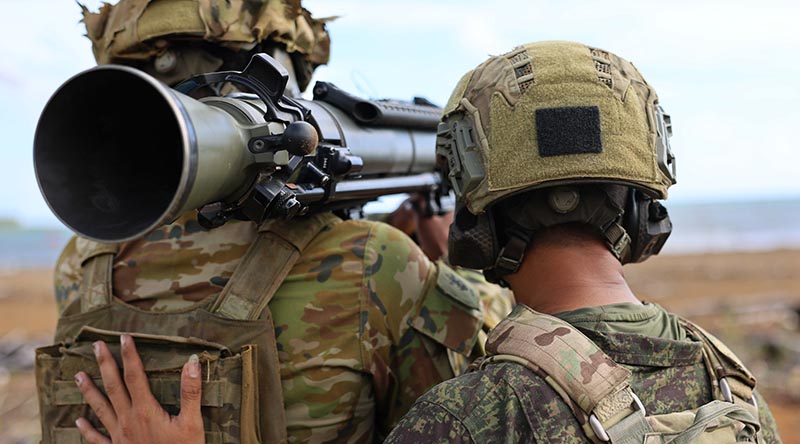
CAPTION: An Australian Army soldier from the 6th Battalion, Royal Australian Regiment, conducts an 84mm Carl Gustaf rehearsal ahead of a coastal-defence live-fire activity with a member of the Armed Forces of the Philippines during Exercise Kasangga in Eastern Samar, Philippines. Story and photo by Captain Tadek Markowski.
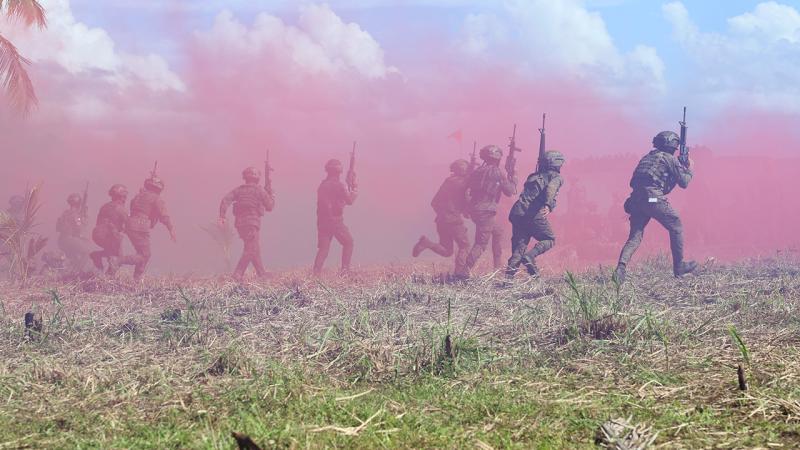
As part of the Joint Australian Training Team – Philippines (JATT-P) program, more than 90 soldiers – primarily from 7 Combat Brigade – conducted a coastal-defence live-fire activity with about 150 AFP counterparts.
Near the town of Polangi, the combined force manned a defensive position between amphibious obstacles, supported by heavy weapons and armoured vehicles.
The live-fire serials zeroed in on targets placed on rafts anchored at intervals off the beach.

It was a dynamic finale to the month-long Exercise Kasangga, which partnered personnel from the AFP’s Samar-based 8th Infantry Division, known locally as the Stormtroopers, with the Australian contingent.
Exercise director Brigadier General Niceforo Diaz Jr said the littoral live-fire was an important learning opportunity for the AFP, as it continued to shift focus from a counterinsurgency skill set to conventional territorial defence.
“It’s a good wake-up call for our personnel who are more used to internal security operations,” Brigadier General Diaz said.
From the coastline, the culminating training serials moved inland, with follow-up jungle operations defending key defensive positions in the mountains – with the Filipino soldiers schooling the Australians in that dense terrain.
“With regards to the jungle environment, that’s where our troops have shared their knowledge,” Brigadier General Diaz said.
“Most of our operations occur in this steep tropical terrain.”
JATT-P coordinator Major Lachlan Newham said the conditions were hard to replicate in Australia.
“The Eastern Visayas and the relatively remote island of Samar are among the wettest parts of the Philippines,” Major Newham said.
“The environment is really challenging – it’s constantly wet, and it’s always hot and the jungle is steep and thick.
“It’s giving our soldiers a real understanding of what it’s like to work in this region.”
Part of an enhanced defence cooperation program, JATT-P supports regular rotations of mobile training teams into the country.
Since its introduction in 2019, training has increased focus on the air, maritime and cyber domains.
Land Mobile Training Team 26-2 comprised soldiers from the Brisbane-based 2/14LHR(QMI) and 6RAR with medical, engineering, signals and logistics support.
Contingent 2IC Captain Aiden Todd said honing dismounted reconnaissance skills and teaching the integration of direct-fire-support weapons was a key goal while working alongside the Filipinos.
“This is the first time that Australia has been [back to Eastern Samar] in a very long time,” Captain Todd said.
“The live-fire was the highlight.
|It really brought together what three-and-a-half weeks of training and integration looks like.
“The ability for us to conduct cross training and work with a partner force in our primary area of military interest is extremely important.”
.
.

.
.


