
Why is it that the Armoured Corps has to continually justify itself?
Share the post "Why is it that the Armoured Corps has to continually justify itself?"

“If we’re going to make a mistake, let’s only make half a one”.
Commander, Australian Forces Vietnam (COMAFV), 1968
There is no doubt that those who have participated in operations involving tanks, become converts to the benefits of armour direct fire support.
So, it was for the first commander of the 1st Australian Task Force (Vietnam), Brig David Jackson. He had been battlegroup commander on Exercise Crusader in 1964 … when, despite the seemingly impassable terrain, the Centurions arrived … just when they were “badly needed”.
The Chief of the General Staff at the time was Lt Gen Sir Thomas Daly. He had been a battalion commander at Balikpapan in 1945, witnessing 1 Armd Regt (AAC) carry the day against Japanese bunkers.
It was he who convinced the minister at the time (Fairhall), that tanks should be sent to Vietnam … having been sent for, the CGS was cut short in his explanation of the role of tanks, with the minister saying “Should the tanks be sent … Yes or No?”.

The reverse also holds true. The Commander 1 ATF, in 1967-68 was Brig Ronald Hughes. When the Centurions first arrived, his ‘welcome’ was: “I didn’t want you, I didn’t ask for you, but now you’re here, I intend to make best use of you”.
The squadron commander at the time, Major Peter Badman, was under the clear understanding that the second shipment of tanks would be sent as soon as the ships became available. It was a surprise, therefore, when he learnt that this was now subject to the approval of the COMAFV (hence the reference above to “only making half a mistake”).
21 May 68 … Brig Hughes had left FSB Coral for R&R. His deputy, Colonel Dunstan (later Lieutenant General Sir Donald Dunstan), decided he wanted the half squadron of tanks brought forward from Nui Dat (150km away). [Dunstan would’ve been aware of the value of tanks from his service as a platoon commander at Balikpapan, as well as his time in Korea.]
Hughes was still in-country and Dunstan asked him to send the tanks. He was informed that he’d have to give the order himself (there was a lot of uncertainty as to whether or not the bridges would withstand the weight of the tanks).
Dunstan gave the order … initiating one of the longest approach marches ever made by Centurions. While the bridges sagged (Class 35, compared to the Class 60 needed for Centurions), they held. [There was no doubt in Dunstan’s mind that he’d be the one held responsible if anything went wrong.]
The subsequent defence of FSBs Coral and Balmoral, and the critical contribution made by the tanks, are among the most famous battles of the of the Vietnam War. Having proved their worth, there was no delay in the shipment of the second half of the squadron (arriving Sep 68).
It wasn’t only Australia that has had mixed feelings about tanks. In 1942, Australian commanders asked for tank support to help overcome Japanese defences at Buna, New Guinea. The request was initially turned down by General MacArthur on the basis that “tanks and artillery had no place in jungle warfare”. The attitude was one which General Westmoreland favoured during his early command in Vietnam … saying that he “wanted no tanks in the jungle” (and ordering that tanks be withdrawn from US units deployed in the field).
Those who held these views were of the opinion that, apart from problems with mobility, armoured units needed much greater logistic and maintenance support. They completely overlooked the fact that the need for close fire support, is a constant no matter the nature of the terrain. Come the latter half of 1966, this is exactly what US field commanders were calling for.
Just because mobility can’t be exploited across open rolling plains, doesn’t mean that the benefits of direct fire support can’t be provided; especially if the tanks involved have high levels of protection.
Footnote: A Head of Corps Ahead of his Time
When Lt Col Ralph Eldridge assumed the appointment of RAAC Corps Director in Nov 56, there was a raging argument in Army HQ. One side argued that Australia needed a light tank; the other that the tank required was one which could survive on the battlefield, whether providing fire support for infantry or engaging other tanks.
The wisdom of Eldridge’s view won the day. He also succeeded in addressing mobility issues. A Joint Intelligence Bureau (JIB) report was the foundation for studies which held that parts of Asia were entirely unsuited for tank warfare. Eldridge identified ground of similar difficulty in Australia and trials were initiated. This led to the JIB findings being discredited.
Lieutenant Colonel Bruce Cameron, MC, RAAC (Ret’d)
.
.
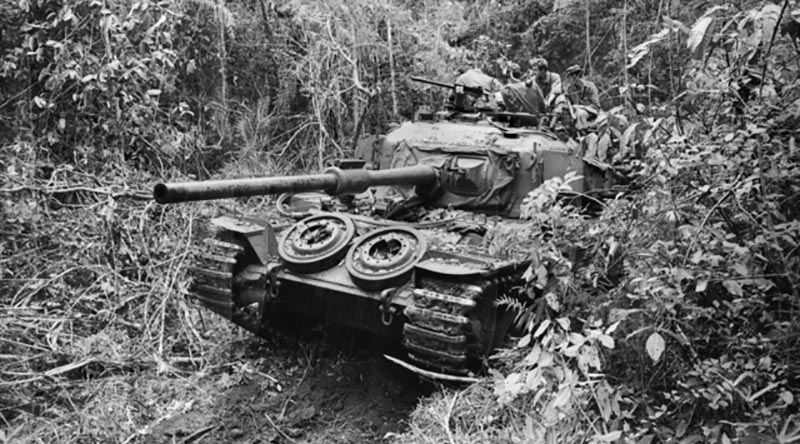
FILE PHOTO: A Centurion tank of C Squadron, 1st Armoured Regiment, moving through jungle in South Vietnam. June 1971. Australian War Memorial file FOD/71/0305/VN.
.
.

.
.


I am someone who walks and runs around base and often pauses to admire the static tank displays at my location. As an ex infantryman I have seen the power that they project and appreciate the direct fire support they offer. But sadly I have to agree that the tank has become somewhat obsolete to our army. The events in Ukraine have highlighted that tanks are more vulnerable in the land and air domains than previously. The comments often made (mostly by tankies) always seem to refer to past employment in WW2 and Vietnam as a justification for leaving RAAC alone to continue its core training. Vietnam was a long time ago and didn’t even allow for the full employment of armoured capability. It was jungle warfare mostly using supporting fire in infantry ops. Not typical armoured warfare. I see time and again in various publications tanks in training areas engaging static or moving targets with mg or main gun, but I find it hard to identify when this capability might be needed in the future. If a conflict to our north occurs, do we really believe that we will be loading up all our M1’s onto LHD’s and C17’s to be deployed in large scale battlefield combat? I don’t think so. The logistical challenge of doing so for our relatively small movements capability is phenomenal. Our M1’s are nothing more than a deterrent force which I believe will remain land locked and will probably never be deployed in large numbers. History has shown us that in our region past conflicts have not supported tank vs tank combat en mass. Indeed, WW2 in our region was a battle of attrition which involved island chains located between ourselves and a northern aggressor and utilising limited amounts of armoured assets. If the DSR is to be considered as a looking glass, then a future conflict will again centre around a battlespace which will not support large amounts of heavy armour involvement. I do feel saddened that the customs and traditions of the RAAC are being threatened as I do with any of the brotherhood within the Army, but at the end of the day we have to roll with the punches and Improvise, Overcome, and Adapt.
Hi Dan,
Thanks for your input. Just a couple of points in response.
Tanks have never been justified on the basis of “typical armoured warfare” in the sense of tank vs tank combat. The whole purpose of the tank in the Australian Army is to provide direct (close) fire support for infantry. This was the role of armour in Vietnam and before that in New Guinea during WWII. The concept of engaging enemy strong points/defences without such fire support, results in an appalling loss of life. Tanks are simply a means of providing mobile fire support. Warfare has not changed in the sense that inevitably infantry have to close with and engage the enemy. Whenever this happens in the future (as it undoubtedly will) I hope Australian infantry will have tanks from 1st Armoured Regiment to support them.
The longer an Army goes involved in I