
A plethora of experimentation units – so why was 1 Armd Regt sacrificed?
Share the post "A plethora of experimentation units – so why was 1 Armd Regt sacrificed? "

The Australian Defence Force (ADF) uses dedicated units, directorates, and multi-agency laboratories to test and evaluate emerging warfighting technologies. Some of these are:
- Australian Army Battle Lab: This is the Australian Army’s tactical experimentation and training unit. It focuses on assessing how the Army fights, integrates, and gains advantage through urban operations, survivability and loitering munitions.
- Joint Experimentation Directorate (JED): A joint-level ADF unit that develops procedures, classified scenario environments, and forward work plans for joint force design and experimentation.
- Joint Experimentation and Wargaming Laboratory (JEWL): Operated by the Defence Science and Technology Group (DSTG) in partnership with JED and Army analysis units, to run networked wargames and capability experiments.
- Littoral Sea Command Laboratory (LSCL): A Navy facility that replicates the command-and-control systems and operations rooms of Royal Australian Navy amphibious ships.
- Army Advanced Capabilities (AAC) office, also known internally as G58, operates out of Australian Army Headquarters. Its primary mission is to explore, experiment with, and evaluate emerging technologies to accelerate land warfare capabilities.
- The Centre for Innovation West is a Royal Australian Navy technology and collaboration hub. It acts as a collaborative workspace and innovation incubator.
- Advanced Strategic Capabilities Accelerator (ASCA) is transforming the way breakthrough military solutions are delivered by rapidly translating innovative technologies into capabilities that will help take Defence further, faster. ASCA is headed by a major-general.
- Brigadier James Kidd serves as the Director General Future Land Warfare at Army Headquarters. In this role, he leads the design, experimentation, and scaling of emerging technologies, managing prominent initiatives like the Army Innovation Series
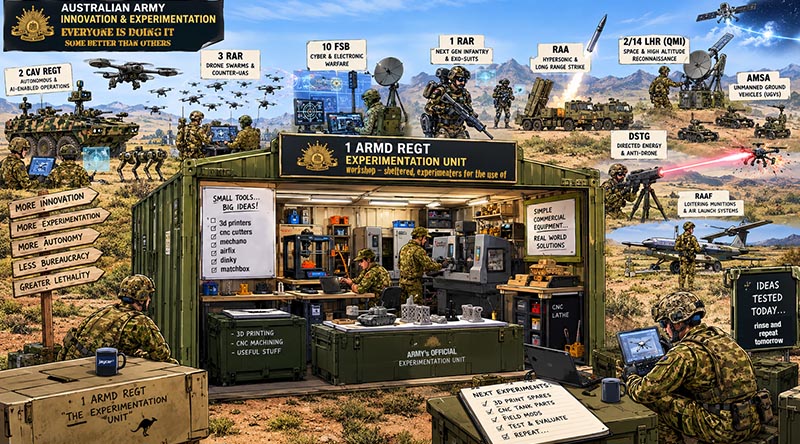
In addition to all these, is 1st Armoured Regiment. In 2023, on the recommendation of the then Chief of Army, the unit was stripped of its tanks and made into a non-combatant experimentation unit, based in Adelaide. In theory, its charter is to test robotics, autonomous systems, unmanned aerial systems, and remote weapon systems.
It has to be assumed that, according to the CA at the time, that an Army experimentation unit was of more importance than the tank regiment that it replaced [though there is a possibility that saving money by reducing armoured vehicle operating costs was a driving factor].
The report below suggests that the unit’s current employment, however, is much more mundane:
“It has now been confirmed that personnel from the 1st Armoured Regiment operated a heavy stores module converted into a deployable advanced manufacturing shelter at Cultana Training Area”.

Is this really why 1 Armd Regt was stripped of its tanks: to equip a unit to be able to mill wood and plastics … at the very time that Army’s combat power has been significantly eroded.
Why is 3 Brigade in Townsville forced to operate short a tank squadron, a cavalry squadron and a battle-group headquarters?
This, at a time when the challenge to Australia’s security outlook, as described by the 2026 National Defence Strategy, is:
The ADF must be able to sustain protracted combat operations during a conflict, including in circumstances involving disruptions to command-and-control networks, infrastructure, logistics networks and communications systems. Defence’s ability to sustain protracted operations despite these disruptions underpins the ability to credibly respond to threats.
Rather than yet another experimentation unit, surely Army’s overwhelming priority must be to maximise its combat power and readiness levels … especially in northern Australia!
Lieutenant Colonel Bruce Cameron, MC, RAAC (Ret’d)
.
.
ChatGPT image
.
.

.
.


