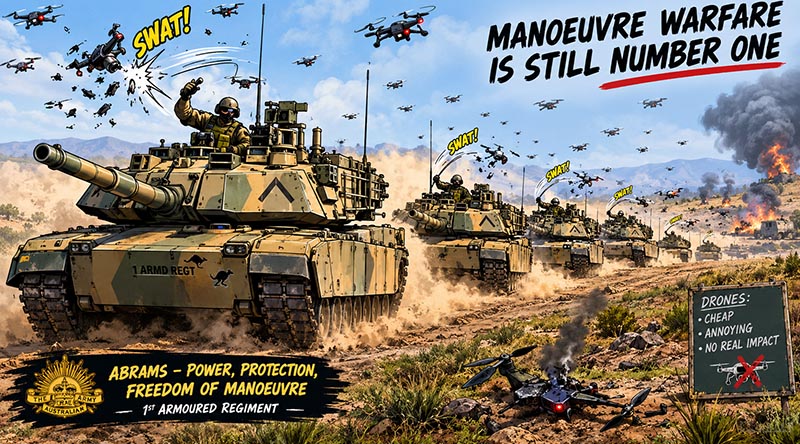
Manoeuvre warfare and the value of tanks

Dear Former Soldier,
I note your comment concerning “the viability of currently conceived tank operations against emerging technologies and weapon systems. You suggest that “Ukraine should have scared the shit out of every turret head, but I have heard very little of change”.
I’ve gathered together a few bits and pieces by way of response.
As feedback from Ukrainian field commanders has recently made clear: “Properly protected, integrated with drones and supported by electronic warfare, armour remains indispensable, particularly when taking ground. We need more tanks to provide close, direct, and overwhelming fire support!”
“Ukraine has not made tanks obsolete, as it is sometimes claimed. It is true that anti-tank mines, omnipresent drones, and an increasingly transparent battlefield have made armour far easier to detect and destroy. However, tanks have still played a crucial role in helping Ukrainian forces to advance, support infantry, deliver protected firepower, and hold or retake ground.”

Further support for the above, is provided by a visiting four-star American general who declared tanks and other combat vehicles are crucial to winning land wars.
“Asked about the importance of armoured vehicles including tanks, General James McConville (until recently, the Chief of Staff, US Army) insisted that the traditional army platforms remained crucial in modern land battles.”
“You don’t need tanks – unless you want to win… that is if you’re going to conduct offensive combat operations. If you want to seize and hold land, the way to do that is with combined arms. Combined arms is tanks, its armoured personnel carriers, its artillery, its attack aviation” … General McConville told reporters inside Australian Defence headquarters.
Manoeuvre warfare has been the touchstone of doing battle since the trenches of the First World War. Has its importance come to an end?
Traditionally, it is a strategy which identifies and attacks the enemy’s weaknesses, while avoiding his strengths. Often referred to as the ‘indirect approach’, it involves by-passing enemy strong points, capitalising on surprise, and disrupting the enemy’s decision making. Rapid and unexpected advances are a hallmark of manoeuvre warfare.
Attrition warfare, on the other hand, is the exact opposite – pitting one’s own strength directly against that of the enemy.
A recent Australian Army Combat Operations manual stated: “In the eyes of the army, without the ability to hold ground, it does not matter how many drones you have, how far those drones can project or what kind of warhead they can employ. If no one is there to occupy the ground, eventually the battle—and subsequently the war—will still be lost.”
So … being able to occupy and secure territory remains, as always, the ultimate end-game. This means, of course, that manoeuvre warfare continues to be the ‘secret’ to winning the next war.
Not that there was any doubt about this, but some writers have created a sense of drones being the solution to all future warfare needs, e.g. “The rise of cheap drones is reshaping global warfare, challenging traditional superpower dominance”.
Google explains manoeuvre warfare as a “military strategy that focuses on movement, surprise, and initiative to gain an advantage. Instead of using raw force in direct frontal fights, it targets an enemy’s weak points and breaks their will to fight”.
Good explanation, but isn’t this the secret of all successful battles … that, and operations based around combined arms?
Drones have obviously changed the conduct of war. The challenge is to understand the nature of the change and use it to advantage. The use of surprise must become the hallmark of the future. Concealment techniques obviously become a priority, but ‘surprise’ is the real key!
Unfortunately, it’s very difficult to achieve. Ground-force mobility is obviously important. Surprise strategic strikes can be achieved with artillery, but the need to follow-up quickly and secure territory occupied, is crucial. This is where armoured forces are important.
Changes undoubtedly have to be made to the conduct of war (as always), however, the role for tanks is an on-going one.
Lieutenant Colonel Bruce Cameron, MC, RAAC (Ret’d)
.
.
ChatGPT image
.
.

.
.