
Soldiers to help shape emerging technologies
Share the post "Soldiers to help shape emerging technologies"

Nine emerging technologies were showcased at this year’s Army Innovation Day (AID) stand during the Chief of Army Symposium 2026.
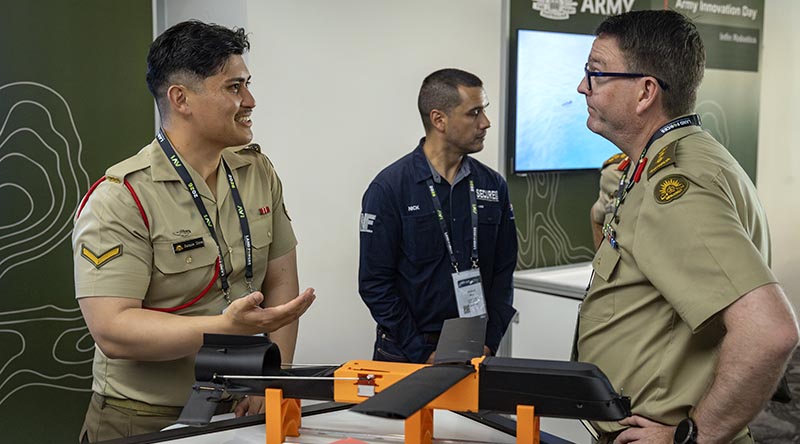
CAPTION: Australian Army soldier Lance Corporal Jamie Dow explains a system to Commander Army Battlelab Colonel Matthew Hodda at the Army Innovation Day stand during the 2026 Chief of Army Symposium. Photo by Corporal Michael Rogers.
Autonomous underwater and surface vessels, a containerised smart mortar and AI-enabled voice control for uncrewed systems will now be taken to the field as part of AID 2026, led by Army Advanced Capabilities and 1 Armd Regt.
Soldiers from the regiment will assess the equipment at Cultana Training Area in South Australia, including access to open water along the training area’s coastline, to put uncrewed surface and sub-surface platforms through their paces.
Trooper Alex Collier, one of the soldiers who is partnering with industry teams to guide their experimentation, said he was excited to help shape future Army capability.

“These products were designed to meet a brief from Army,” Trooper Collier said.
“It’s anticipated that these capabilities will be required by Army in the future.
“However, they aren’t necessarily in their final form.
“That’s where we, the soldiers, come in.
“We experiment, evaluate and give feedback to determine what is performing well, or whether the designers need to go in a different direction.”
According to Director Army Advanced Capabilities Colonel Jake Penley, AID 2026 focused on autonomous mass in littoral warfare, supporting the aims of Australia’s National Defence Strategy.
He said autonomous systems would play an important role in information, surveillance and reconnaissance, strike and logistics missions during operations in archipelagic warfare.
“These platforms offer cost-effective solutions to ensure that our people, who will have to close with and potentially kill the enemy, have an advantage over their adversary,” Colonel Penley said.
“Some of the systems involved in AID26 have a realistic chance of providing that advantage.
“It’s about generating an unfair fight tipped in our favour.”
Among the technologies selected for testing was the Seeker AUV from Seascape Autonomy, part of the University of New South Wales.
As an autonomous underwater vessel, Seeker AUV can conduct high-fidelity radiography scans in littoral environments without exposing operators to potential danger.
Also selected to undergo trials was Avalon from Breaker Industries, which uses artificial intelligence to enable voice control of uncrewed systems.
Following testing, Army will provide detailed feedback to each company to determine whether further development is required.
Colonel Penley said Army’s combat experimentation capability allowed closer collaboration with industry and provided clear guidance on capability requirements.
“It allows us to work with industry to make sure that we’re getting the best product to increase the lethality of our soldiers while making the best use of Commonwealth funds,” he said.
Brigadier James Kidd, Director General Future Land Warfare, Army Headquarters, said Army’s intent was to expand the AID program.
“From 2027, Army Innovation Day will change to the Army Innovation Series,” Brigadier Kidd said.
“This reflects the iterative nature of experimentation and adaptation.
“We are grateful to our current participants for their willingness to work with us on what that might look like going forward.”
.
.

.
.


