1st Armoured Regiment’s heritage – why it’s important it not be forgotten
Share the post "1st Armoured Regiment’s heritage – why it’s important it not be forgotten"

A unit’s heritage is that which creates the esprit-de-corps on which morale is based. It is this, in turn, which generates the infectious confidence, enthusiasm, and loyalty within a unit.
High morale means a group feels positive and motivated, while low morale means they feel discouraged and unhappy. It is high morale which adds to a unit’s combat power.
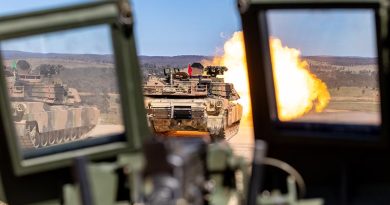
1 Armd Regt was, for 75 years, a tank regiment; the senior regiment of the senior Corps – the Royal Australian Armoured Corps.
However, the then Chief of Army decided that he wanted an experimentation unit to evaluate new and emerging technologies.
1 Armd Regt’s location in Adelaide, meant that this was the cheapest option; so, the unit was stripped of its tanks. As a non-combatant, it no longer has an RAAC role.

One would’ve hoped that a decision of this type, one affecting the very fabric of everything the unit stood for, would have been brought to everybody’s attention and discussed by all involved.
Not so … what was about to happen was kept a secret until the very last; 1 Armd Regt’s Honorary Colonel was as surprised as everyone else.
The deceit involved, made a mockery of the open and honest principles advocated by the former CA. There were no discussions with unit stakeholders … just an announcement after the decision.
The 1 Armd Regt Association was advised by several respected retired Armoured Corps generals that the decision to re-role 1 Armd Regt would surely be reviewed and that common sense would undoubtedly prevail. In the meantime, the Association and veterans of 1 Armd Regt, were advised to remain calm and not undertake a campaign of advocacy which could inflame a sensitive situation.
This advice was totally wrong. The removal of 1 Armd Regt from its combat role was an unconscionable act by a desperate CA (trying to pull a rabbit out of a hat).
So it was that the RAAC’s oldest and most decorated ARA unit, was removed, unilaterally, from combat duties. No longer would it be crewing tanks to develop the skills to destroy the enemy and provide intimate fire support to infantry, as it had since 1949 …
Was it an ethical decision? There is no field in which trust is more important, than the profession of arms. Trust … the result of a working environment in which human values are paramount: the dignity of the individual is respected; undertakings are honoured; those in need are helped; and decisions are taken which result in just outcomes. It was completely misplaced in the case of 1 Armd Regt.
Why was the decision kept secret? Many have commented that the decision was not publicised in any way; rather, it only became known on the day the Defence Strategic Review (DSR) became public, i.e. that 1 Armd Regt had been dumped from the order of battle. Simply put … the RAAC, its stakeholders and veterans, were ambushed.
But then again, how could anyone understand beforehand, the implications of what had been done? A unit which had spent 75 years learning to survive and win on the battlefield, day after day … was simply axed from the order of battle. No apologies, nothing! Not even the chance for former members to plan a farewell.
Some years ago, there was a proposal to merge the British Parachute Regiment and the Royal Marines in order to help reduce the Defence budget. There was outrage in Britain! Front page news described the plan as “horrifying” and “unthinkable” and a heated debate took place in Parliament. Fury was sparked among veterans and a petition was launched, attracting more than 4000 signatures. The backlash was so intense that the proposal was withdrawn. Interestingly, one of the most common criticisms was that it would “destroy unit ethos”.
A similar response might have been the case here, if public feelings had been aroused. Why weren’t they? Authoritative advice was to avoid any advocacy which could inflame a sensitive situation. The moment passed.
Senior RAAC officers made multiple representations to the former CA to reverse the decision. It was not to be.
A far better arrangement would be for the 1st Armoured Regiment HQ to be raised in Townsville to command the tanks, with 2nd Cavalry Regiment commanding the reconnaissance elements. This is the position of the RAAC Representative Honorary Colonel, as agreed at the Corps Conference. It has the added advantage of enabling 1st Armoured Regiment and 2nd Cavalry Regiment to each form battlegroups; thereby significantly increasing the combat power and flexibility of 3 Brigade.
But the CA had his mind made up and that was it … no going back!
The former CA said that: “Putting Australian soldiers on the ground and in harm’s way, remains the ultimate expression of our nation’s will and resolve”. 1 Armd Regt had been a proud benchmark in this respect for 75 years. Amazingly, that responsibility has now been passed, unilaterally, to others.
What is the future for a proud 1 Armd Regt which is no longer in harm’s way and can no longer strive to be the ultimate expression of our nation’s will and resolve? Can it ever be the same, even though it may have new responsibilities in other fields as a non-combatant? Of course not.
The role of the RAAC involves closing with and engaging the enemy. The unit ethos, esprit de corps, heritage, tank-craft and skills built up by 1st Armoured Regiment over 75 years, are completely lost, now that it is no longer a combatant on the order of battle.
An annual parade and commemoration have always been held by 1st Armoured Regiment on Cambrai Day (20 November) in recognition of the battlefield success of tanks during the First World War and the alliance entered into between the Royal Tank Regiment and 1 Armd Regt in 1951. Sadly, this alliance of ‘sister regiments’ no longer has any basis for retention; nor is there any armoured heritage to commemorate on future Cambrai Days.
The 1st Armoured Regiment badge was designed to acknowledge the unit’s role in operating tanks to close with and engage the enemy. Why should it continue to be worn by a unit that has no association whatsoever with tanks, let alone a combat role? The same can be asked about the RAAC’s distinctive black beret. If it was the intention of Defence to completely wipe a unit’s reputation from the ADF ledger, this has been successfully achieved.
General Coyle, you have it in your hands to either completely destroy a once proud Army unit OR to raise 1 Armd Regt’s Regimental HQ in Townsville and have it command 3 Brigade’s tank squadrons. We ask that you choose the latter.
We are a group of veterans among whose collective efforts were those which contributed to the award of the three battle-honours emblazoned on the 1st Armoured Regiment’s Standard, as well as the Unit Citation for Gallantry awarded for the Battles of Coral-Balmoral.
“We seek this so as to continue to honour the service and sacrifice of tank crews during the past 75 years, creating an inspirational legacy worthy of being passed on to those serving today”.
Lieutenant Colonel Bruce Cameron, MC, RAAC (Ret’d)
.
.
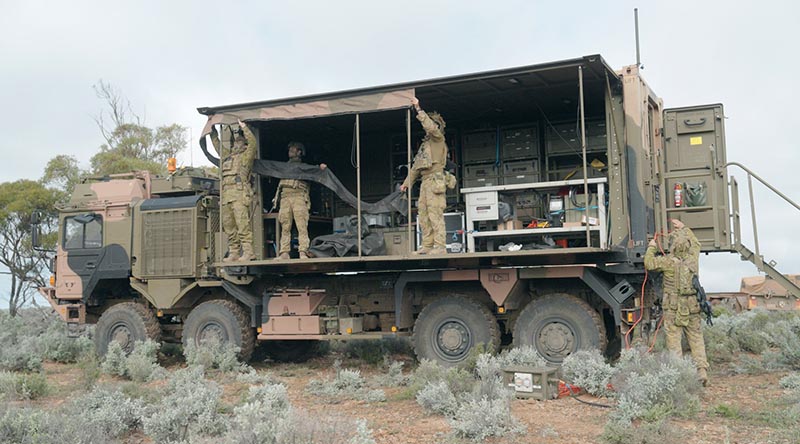
FILE IMAGE: 1st Armoured Regiment soldiers set up a deployable manufacturing shelter, at Cultana Training Area, South Australia, to make spare parts for drones. Photo by Michael Guo.
.
.

.
.