A Concise History of the RAAC

Alternative title: The Fighting Spirit of Soldiers: What NOT to do … to Keep it Alive!
“The Australian Army still seems to retain an ‘infantry’ outlook … it has allowed her infantry force to grow while armoured units have slowly lost ground both in numbers and fighting potential.”
Major General R N L Hopkins, CBE (Retd), 1978
Background
One of the most important parts of a soldier’s fighting spirit, is his morale. A measure of this is preparedness, both individually and collectively, to enthusiastically make the effort needed to achieve the goals set by his commander. Morale, along with ammunition and equipment, forms part of an Army’s combat power. Good leadership is central to good morale.
Doing something for the first time is never easy. In 1929, the 1stTank Section in Sydney, equipped with four Vickers Medium Mk II tanks, was Australia’s first armoured unit. Crews were members of the newly gazetted Tank Corps (or thought they were). It was here that the new corps experienced its first set back … many more were to follow. Time and time again, entrenched attitudes won the day, and are still doing so.
In 1932, it was discovered that a Tank Corps was not permitted under the Defence Act, as it existed. The Corps whose duties were closest to those of tank crews, was the Australian Army Service Corps. Not an ideal situation as far as morale was concerned, but the crews had no say. This would remain so for the next nine years.

Second World War
Unsurprisingly, the Japanese attack on Pearl Harbor in December 1941, totally changed planning for the defence of Australia. The newly formed 1st Armoured Division would no longer be deployed to the Middle East, where it was to have been equipped with tanks. Instead, both the UK and US quickly dispatched tanks to Australia. The Australian Armoured Corps (AAC), which had finally been approved six months earlier, was reorganised on the basis of three armoured divisions, plus a tank brigade. (Each division comprising three armoured regiments, three motor regiments and an armoured car regiment; twelve tank regiments in all.)
Armoured Fighting Vehicles (AFVs) from divisional cavalry regiments had already seen action in the Middle East, but a new importance and urgency now existed. Not only was there the threat of invasion, but the nature of warfare itself had changed. The experience of blitzkrieg in Europe made it very clear that the conduct of mobile warfare had to be quickly mastered, both in terms of AFVs and their tactics. Raising three armoured divisions from scratch was an enormous challenge and the AAC would have to establish training units to augment the newly established AFV School at Puckapunyal. This process would be complicated by the availability of tanks and the tyranny of Australia’s geography. The AAC and mobile warfare were undoubtedly seen to be at the heart of the nation’s defence at this time.
Come 1943, glorious relief … the threat of invasion was over! Despite there now being over 1000 tanks in Australia, the armoured divisions were disbanded in favour of other priorities. When operating in close-country, for example, direct fire support for infantry was more important than ever. 4 Armoured Brigade was formed in February 1943 for this purpose, resulting in AAC crews operating Matildas and General Stuarts in support of Australian forces in New Guinea and Borneo. 1st Army Tank Battalion (renamed 1st Armoured Regiment in 1945) subsequently received nine Battle Honours for its service in the South West Pacific Area.
Armoured units were rapidly disbanded following the cessation of hostilities in 1945. Before long the 1st Australian Armoured Car Squadron was the only Regular Army unit left to carry on the traditions of the AAC (one of which was the black beret, having been formally adopted as the headdress of the Corps with the approval of King George V in 1924). Formed in 1946 for service with the British Commonwealth Occupation Force in Japan, the armoured car squadron would provide the manpower for a new armoured regiment when it returned from Japan.
The Cold War
1st Armoured Regiment was renamed for the third time in 1948, becoming 1st Armoured Regiment (Royal New South Wales Lancers). It was one of the new CMF units designated to form part of the post war armoured corps. King George VI granted approval on 14 December 1948, for the prefix ‘Royal’ to be adopted by the AAC. Six months later, on 7 July 1949, 1st Armoured Regiment, RAAC, came into being …albeit with a single squadron of Churchill tanks. To avoid confusion, 1st Armoured Regiment (RNSWL) adopted the title 1st RNSWL (amalgamating with 15 Northern River Lancers in 1956).
Centurion tanks finally started to arrive in Australia in late 1951, the order having been placed in mid-1949. The implications as far as the on-going Korean War were concerned, were significant. The pre-eminent role of the tank on the battlefield was well accepted and this created the need to commence planning for a 2nd Armoured Regiment. A ‘Nucleus’ Squadron was established in Holsworthy to this end.
Disappointingly, however, the delay with Centurion deliveries meant that there was no opportunity for 1st Armoured Regiment to gain operational experience (nor with the 1953 Armistice, did the second regiment ever come to be). Interestingly, New Zealand purchased a Centurion tank in 1950 and used this to train tank crews which were then attached to British tank units in Korea; thereby gaining valuable first-hand armoured experience. On 6 February 1956, the then Governor General, Field Marshal Sir William Slim, presented 1st Armoured Regiment with a Guidon. Traditionally carried by cavalry units, this swallow-tailed heraldic banner embodies the honour and traditions of an armoured unit.
Five CMF units were designated as tank regiments, reflecting the importance of mobile warfare in the defence of the nation. Providing the small number of home training tanks, as well as a pool of tanks for annual camps, created major problems for the AAC through the 1950s. General Grants, Matildas and Staghounds had to be pressed into service.
Fortunately, come the end of deliveries in 1961, 1st Armoured Regiment was complete with three Centurion squadrons plus supporting variants, and CMF needs were met. This set the platform for four tank squadrons to successively provide close fire support for infantry in Vietnam during 1968-71.
A Breather.
The fleet of 132 Centurion tanks (including 15 purchased in 1971 from British Army stocks in HK), plus support variants, was replaced by 90 Leopards (plus support variants) in 1977.
Qualifying as the modern-day equivalent of a heavy cavalry (dragoon guard) unit which traditionally carried a Standard, the Colonel-in-Chief of the RAAC, the Prince of Wales (now King Charles III), presented the unit with its first Regimental Standard on 21 April 1981.
A former member of the Regiment noted that the Vietnam Theatre Honour stated ‘Vietnam 1968-72’, despite the last tank troop being withdrawn from operations in 1971. Furthermore, the Battle-Honour Coral-Balmoral was not emblazoned, when authority to do so had been granted. Following a letter to the Minister, these mistakes were corrected and a new Standard was presented by the then Governor-General on 13 July 2002.
Almost 20 years later (1995), 1st Armoured Regiment was relocated from Puckapunyal to Darwin. Strategic thinking was obviously reflected here in terms of the threat analysis and contingency planning.
The Start of the Long Decline
In 2007, the Leopard was replaced by the Abrams M1A1 tank; but only 59 of them. Surprisingly, given the importance seemingly vested in northern defence, tank numbers had been reduced to less than half that of the former Centurion fleet. How could this be? Studies of the need for defence self-reliance have constantly pointed to the danger of relying on overseas sources of supply. It cannot be assumed that the fortunate circumstances that occurred during the Second World War, will happen again.
It was not long before strategic guidance changed again; a totally new Army organisation being announced in 2011. Multi-role combat brigades were to be deployed to Darwin, Townsville, and Brisbane; each comprising two battalions and an Armoured Cavalry Regiment (ACR). Each ACR had a tank, APC, and recon squadron (similar to the functional groupings within each armoured division in 1942). Deployments were to occur over a number of years.
A shortcoming would soon become apparent. While there were sufficient Abrams tanks if all were centrally located (as 1st Armoured Regiment had been before the ACR organisation), there were not enough to provide adequate maintenance and repair pool support across three separate locations. This was partly addressed by Army. The replacement for the Abrams M1A1 was to be the M1A2 SEPv3, as used by the US Army; and 75 were to be purchased. Not as many as the 90 which those within Army stated were needed, but a valuable increase to capability, nevertheless.
Somewhat surprisingly, Defence revealed more organisational changes. Firstly, APCs were transferred to the infantry, pending introduction of the Infantry Fighting Vehicle (IFV). Some RAAC personnel felt that this was not before time, given what they regarded as the two fundamental armoured roles: reconnaissance and what was now deemed ‘manoeuvre warfare’ (involving operations in which a force capitalises on achieving surprise using shock action). But how would the loss of the armoured mobility role impact the RAAC? There would now only be the equivalent of two, rather than three, regular army units. Time would tell what this mean.
The second change created greater surprise when it was announced in 2017: 1st Armoured Regiment was to be moved from Darwin to Adelaide. The new organisation in South Australia would be one tank squadron, two ASLAV squadrons and one ARES squadron (3/9 SAMR, operating protected mobility vehicles-light; 9 Brigade becoming an integrated ARA/ARES brigade.) Given subsequent events, one has to wonder if there was a longer-term plan in the wings?
Strategic Review Changes All
Incremental changes are relatively easy to adapt to; total and fundamental change calls into question the rationale on which it is based. 2023 was a year of one such turn-around. Having just got used to multi-role brigades, these were now scrapped. Instead, all tank squadrons were to be concentrated in Townsville as part of an armoured brigade (1 Brigade); 3 Brigade in Darwin was to become a light brigade; and 7 Brigade in Brisbane was to become a motorised brigade. 2 Cavalry Regiment was at that time in Townsville; what was to become of 1st Armoured Regiment? Would it resume its place on the right of the line, the senior regiment of the Australian Army; the only unit with the right to carry a Standard?
No. A person, or maybe it was a committee, decided that, in its 75th year, 1st Armoured Regiment was to be re-roled as ‘an experimental unit to deliver and integrate emerging technologies’. It may well be that the new role is an important one; but that is not the point.
The fighting spirit and morale of a unit is something built up, year by year, during its existence. It is the sum of Battle Honours, reputation, traditions, heritage and folk-lore. This is particularly so when a unit has established itself as the exemplar of manoeuvre warfare and shock action, a pre-requisite for which is a commander who leads from the front with dash and elan.
Conclusion
There was a choice. It did not have to be 1st Armoured Regiment that was made non-operational. As explained by Wikipedia: “The removal of 1st Armoured Regiment as a combat unit, the RAAC’s oldest regular unit and one of its most decorated, effectively reduces the number of active combat Armour units in the Army to two; the 2nd Cavalry Regiment in Townsville and 2nd/14th Light Horse Regiment in Brisbane”.
These ARA units were formed in 1965 and 2005 respectively. The latter was an ARES unit which was brought onto full time duty to help Army meet its then operational demands.
Why not make 1 Armoured Regiment the 3 Brigade tank regiment in Townsville, along with 2 Cavalry Regiment (as per the Defence Strategic Review); and make 2/14 LHR Regiment (QMI), the experimentation unit in Adelaide?
The answer would seem to be administrative convenience and cost; rather than relocating two units, it would be much less expensive just to retain 1 Armoured Regiment as the experimentation unit in Adelaide.
BUT, is this the way it should be? Does preservation of esprit de corps, fighting spirit, unit heritage, and morale mean nothing?
Lieutenant Colonel Bruce Cameron, MC, RAAC (Ret’d)
.
.
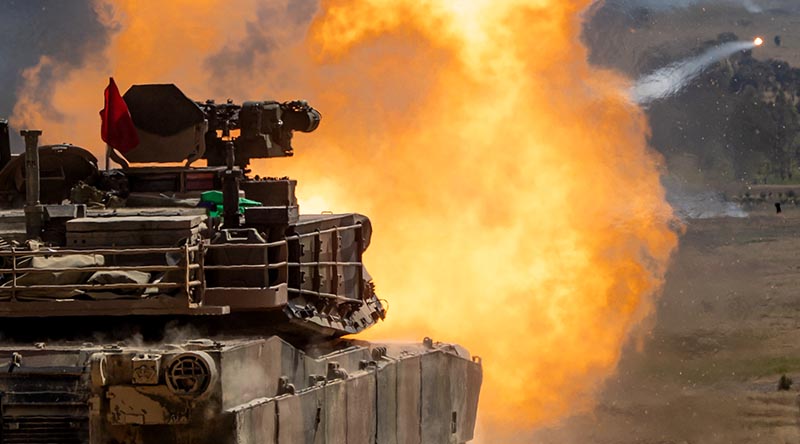
FILE PHOTO: An Australian Army Abrams M1A2 SEPv3 main battle tank during a live-fire serial as part of a qualification course for Royal Australian Armoured Corps soldiers at Puckapunyal Military Area, Victoria. Photo by Corporal Jacob Joseph.
.
.

.
.