Why returning 1 Armd Regt to combat role should be high on new CA’s priorities list
Share the post "Why returning 1 Armd Regt to combat role should be high on new CA’s priorities list"

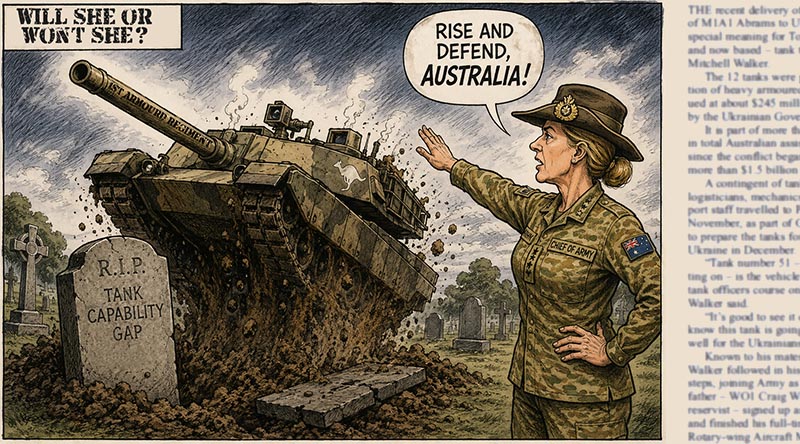
Will returning 1st Armoured Regiment to its combat role be something Lieutenant General Susan Coyle should list high among her priorities?
How can she be convinced that this should happen?
The principal reason is to return 3 Brigade to the armoured brigade status it was intended to be when the Defence Strategic Review was initiated. Presently, it is short a tank squadron, a cavalry squadron and a battle-group headquarters.
In order to train properly, Regimental Headquarters 1 Armd Regt must be re-established and the tanks assigned to it. The 2nd Cavalry Regiment must, in turn, become a cavalry regiment in its own right, not an incompatible dual-role unit, as it is now.
This is in accord with the recommendations of the RAAC Representative Honorary Colonel, Major General Michael Krause, who pointed out that:

“The creation of an Experimental Unit in Army is sensible and useful, but it has no relationship with 1 Armd Regt. That is, the two are separate ideas and calling the Experimental Unit 1 Armd Regt is both unnecessary and actually confusing.
The best operational outcome for Army is to form two battlegroups in Townsville, one commanding the cavalry and one commanding the tanks. This has benefits for training and operational focus.
1 Armd Regt was formed in 1949 and has been an armoured regiment for 75 years. When its tanks were stripped from it and it was made an experimentation unit, the heritage of the RAAC’s longest serving ARA unit was completely lost.
This was a unit which was awarded the Battle-Honours Coral-Balmoral, Hat Dich and Binh Ba for its service in Vietnam. A Unit Citation for Gallantry was also awarded to C Squadron for its extraordinary gallantry during the battles of Fire Support Bases Coral and Balmoral in 1968.
Does the heritage of a unit stand for nothing? The battles it fought, the honours it has been awarded; can these be discarded as if they have no significance at all? Of course, not … but that’s what’s happened.
Yet it is these very things, which form the morale of a unit and contribute to its combat power.
Just days ago, the outgoing CA referred to the Army Banner (which was unfurled behind him during an address at the AWM) saying that it was “the grandest item we (i.e. the Army) possess”. How can this be?
How is it possible to assign comparative status to say, 6RAR’s Colours or 1st Armoured Regiment’s Standard? Surely their whole significance is to the Unit that bears them. How can the Army Banner be ranked the ‘most grand of all Army’s possessions?’.
Is nothing sacred? How is it that Regimental honours can just be tossed on a scrap heap. Why would anyone do this? There is much which has been kept secret, but as far as is known…
The former Chief of Army wanted a unit that could evaluate new and emerging technologies. A new unit could very easily have been raised; but no … the CA wanted one which could ‘hit the ground running’ (in order to make up for time lost by earlier procrastination). So it was that 1 Armd Regt was stripped of its tanks and became one of the Army’s numerous experimentation units.
Could it be argued that the Nation’s security was assured and Australia had plenty of time in which to consider defence matters? No … the situation was exactly the opposite!
Lt Gen Coyle was very direct on this point – Australia’s incoming Chief of Army has delivered a blunt warning about whether our Defence Force is properly prepared for the realities of modern warfare.
This is certainly what authorities on Australia’s current strategic situation, would like to see made known: “As of May 2026, Australia faces its most challenging strategic circumstances since WWII, driven by intense regional power competition and a deteriorating security environment”.
This is in keeping with independent data from the Australian Strategic Policy Institute (ASPI) which warns that Australia is highly exposed right now …
“Failing to Deter Today: Critics argue that Australia’s strategy of “impactful projection” relies heavily on future acquisitions—such as the AUKUS nuclear-powered submarines—which will not materialize until 2032. This creates a gap in immediate, credible deterrence against regional aggression.
Unprepared for Immediate Conflict: The current force faces significant near-term strain, including acute personnel shortages, limited munitions stockpiles, and reduced funding for immediate sustainment. Analysts worry this creates a “paper ADF” that looks capable on future balance sheets but lacks the mass and resilience required for a sudden crisis today.”
Many would say that returning 1 Armd Regt to a combat role is the very least that should be done!
The June 2026 1 Armd Regt Assn newsletter advised that: “Throughout the first half of 2026, the Regiment continues to set the standard for Army’s innovation and adaptation.”
What a pity it is that the standard for armoured warfare can no longer be found!
Lieutenant Colonel Bruce Cameron, MC, RAAC (Ret’d)
.
.
ChatGPT image
.
.

.
.