
Australians continue to train Ukrainians

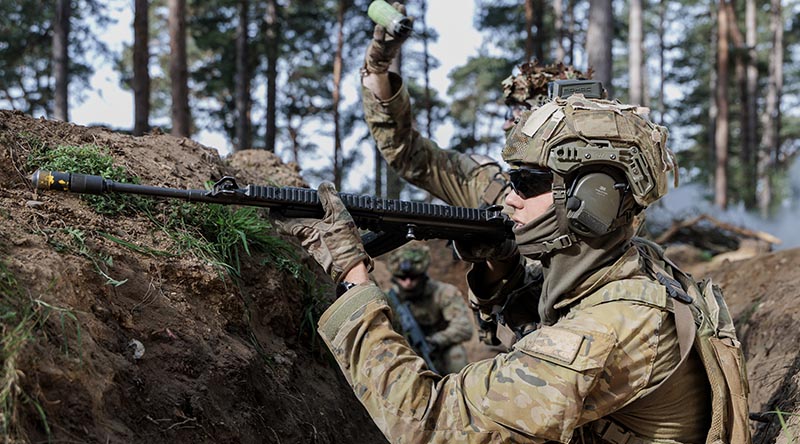
Trench lines stretch across the training area as drones buzz overhead – a constant reminder that modern warfare demands more than tactics alone.
CAPTION: Australian Defence Force personnel demonstrate a training serial for Armed Forces of Ukraine personnel during a section commanders’ battle course on Operation KUDU 26. Story by Lieutenant Tahlia Merigan. Photo by Sergeant Samuel Miller.
On Operation Kudu, Australian instructors are preparing Ukrainian soldiers not just to fight, but to command in a complex and constantly evolving battlespace.
Australian Training Team Commander Major Jarrad Dekuyer said the Australian contingent was delivering leadership training from section commander through to platoon and company level.
“The current rotation places a strong emphasis on leadership, pushing commanders to think beyond the immediate fight and control the broader battle,” Major Dekuyer said.

At the section level, instructors said one of the biggest challenges was getting leaders to step back from instinctively leading from the front.
Australian lance-corporal trainer said that when you’re at the front, you get tunnel vision.
“We’re trying to help them see the bigger picture and control everything happening around them.”
In modern combat, how a leader positions themselves can determine not just success but survival.
As training progresses, that picture expands.
At platoon and company sergeants’ level, scenarios are used to develop command and decision-making under pressure.
“This isn’t a purely tactical course,” an Australian corporal instructing on the platoon and company sergeants’ battle course said.
“We’re using the scenarios to teach command and leadership – that’s the real focus.”
Trainees move through a range of environments, from open terrain and trench warfare into urban operations, culminating in a company-sized assault requiring coordination, control and clear communication.
A defining feature of the training is how closely it reflects the current fight.
Many Ukrainian soldiers arrive with recent combat experience, and those lessons directly shape how instruction is delivered.
“A lot of the trainees have been in conflict for several years,” the Aussie corporal said.
“They question techniques based on what’s worked for them, but once they understand the reasoning, they’re very receptive.”
That experience has led to a common perception that there is little left to teach.
Major Dekuyer said there was a misperception there could be nothing to teach an army that has been at war for four years.
“The Australian Army has developed a very strong junior and senior non-commissioned officer corps.
“Those leadership lessons are what we’re able to share with the Ukrainian Army,” he said.
The exchange goes both ways.
“One of the biggest lessons we’ve learned from the Ukrainian soldiers is resilience,” Major Dekuyer said.
Modern threats, particularly the constant presence of drones, have driven significant changes in how commanders operate.
The Aussie corporal trainer said drones were heavily saturated in their battlespace.
“That’s forced us to adapt and focus on how leaders operate under constant observation.”
Medical planning has also shifted. With evacuation often delayed, commanders must plan for prolonged casualty care.
“The golden hour doesn’t really exist in the same way,” the corporal said.
“Leaders need to be prepared to sustain casualties for longer while continuing the mission.”
Ultimately, success isn’t measured by performance on the training ground, but by how these leaders adapt when they return to the front – equipped to make decisions, maintain control and lead in the chaos of modern war.
Operation Kudu’s multinational environment adds further depth, with Australian instructors working alongside European partners as part of the UK-led Operation Interflex.
.
.

.
.


