
Alleged Afghanistan war crimes and the execution of ‘Breaker’ Morant – A Perspective
Share the post "Alleged Afghanistan war crimes and the execution of ‘Breaker’ Morant – A Perspective"

The allegations of war crimes against Ben Roberts-Smith echoes a similar occurrence during the Anglo Boer war and the trials of three Australian volunteers – Lieutenants Harry ‘Breaker’ Morant, Peter Handcock and George Witton.
Former Prime Minister Morrison, announcing the appointment of a special investigator to consider evidence of alleged criminal acts against some SAS personnel in Afghanistan, stated: “It is our Australian way to deal with these issues with a deep respect for justice and the rule of law – but also one that seeks to illuminate the truth (and) seeks to understand it” (press conference, Parliament House, 12 Nov 2020).
That is a laudable aspiration. However, it remains to be seen if this principle is applied to Ben Roberts-Smith’s trial or is Australia witnessing a cover up exercise to protect senior commanders, in Afghanistan and Canberra, from liability for being knowingly concerned or showing blind indifference in war crimes.
The other concern we are now witnessing is a media circus driving a prejudicial stampede to attack Ben Roberts-Smith prior to a trial. This was on display as the media covered an orchestrated arrest of Ben Roberts-Smith in the presence of his children at Sydney airport in the glare of cameras and later when he was filmed entering Sydney’s Silverwater Correctional Complex.
The conduct by senior management of the AFP and other actors has been criticised for driving public opinion to convict Ben Roberts-Smith before trial. Australians who believe in the sanctity of due process and to eliminate prejudicial conduct will condemn the conduct of law enforcement to the detriment of the principle of fairness and innocent until proven guilty. Critics have alleged the orchestration of the arrest was prejudicial to the principle of ensuring Ben Roberts-Smith’s entitlement to a fair trial.

Ben Roberts-Smith’s arrest could have been facilitated without the glare of media cameras and reporters. It’s not as though Ben Roberts Smith was attempting to flee Australia, he could have been invited to meet with police or at another place without the hungry media presence implying guilt. The stink of an orchestrated arrest, collusion between AFP command and media raises serious questions of who facilitated the involvement of the media and was the PM consulted?
AFP and the Office of Special Investigator had been investigating Ben Roberts-Smith for years and would have been aware of his location and movements. The AFP, under the command of Commissioner Barrett, has a case to answer about unethical conduct. The buck stops with the Commissioner in allowing this to occur.
The smell of scapegoating of Ben Roberts-Smith resonates with the Morant trials. These men were not tried according to the law of 1902 and were denied procedural fairness and suffered a terrible injustice. Can Ben Roberts Smith receive a fair trial?
The controversy about the treatment of these Australians contains lessons for us in the current situation regarding Ben Roberts-Smith and other accused SAS soldiers. It remains a stark reminder that holding junior military personnel to account in a stampede of investigation and prosecution permits the deflection of possible liability among senior commanders and political leaders both in the field and in Canberra.
Considering the SAS investigation, the Morant case provides an opportunity to balance the assessment of allegations with the preservation and promotion of the rule of law to ensure those accused are given the presumption of innocence, proof beyond reasonable doubt and treated in accordance with common and statutory law. Nothing less is unacceptable in a civilised society.
The trial and sentencing of the three Australians in 1902 is a stark reminder that unless allegations of war crimes are tried according to law, martyrs can be created and unless the law is strictly followed, a sense of injustice is the result.
In the Morant case, the injustice prevails to this day.
The criminal liability of senior British commanders in 1902 was blatant, but the scapegoating of these Australian volunteers ensured British officers escaped liability and the executions appeased Boer Command during negotiations to bring a vicious war to an end.
Let’s ensure that the same injustice is not repeated. If Australian commanders in Afghanistan and those in Canberra were knowingly concerned, passively or actively, in aiding and abetting war crimes, or showing blind indifference, then they should be held to account to ensure scapegoating of junior officers and NCOs is not repeated.
As the prosecution of Ben Roberts-Smith looms, the culpability (if proven) of senior commanders, must prevail despite a temptation to pacify the outrage expressed in public and media arenas. This will need to examine confronting considerations involving senior military officers and possibly government minister/s and senior departmental bureaucrats.
Morrison’s reference to illuminating truth is aptly reflected in a key legal doctrine under international criminal law Article 28 of the Rome Statute of the International Criminal Court, responsibility of commanders and other superiors.‘A military Commander or a person effectively acting as military commander shall be criminally responsible for the crimes within the jurisdiction of the court committed by forces under his or her effective command and control, or effective authority and control as the case may be, as a result of his or her failure to exercise control properly over such forces’.
Australia must be assured that while Ben Roberts-Smith is prematurely judged to be guilty, can we be certain that in the chaos of a brutal war some senior commanders knew, or should have known crimes were occurring and failed to take necessary measures to prevent or report them. Are they being held to account under Military or criminal law – because the claim that no one knew about war crimes is not credible?
James Unkles
Commander (Retd)
.
.
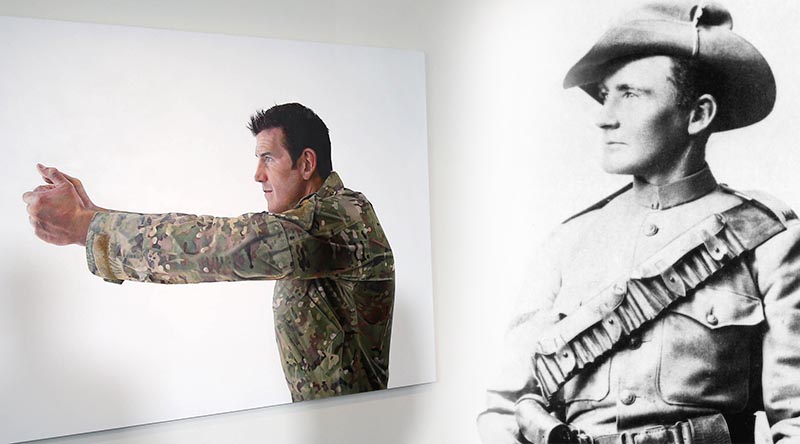
Digital composite image: A portrait of Corporal Ben Roberts-Smith at the Australian War Memorial, by Michael Zavros, superimposed with a photo of Harry ‘Breaker’ Morant.
.
.

.
.



G’day All, I’m ex-RAAF; a published author, former journalist for The Age and for the past 16 years I’ve been a military historian. My deep interest in all things military has been with me for most of my teenage and adult life.
I’ve made an extensive study of the ‘Breaker’ Morant cases but, sadly, due to work pressures on other military history projects, I’m not as much ‘up to speed’ on the Ben Roberts-Smith case as I intend to be in the future.
Firstly, if Mr Roberts-Smith is found to be guilty in a civilian court by a jury of his ‘peers’ then he, under the law, should expect a harsh punishment. The only positive note is that Australia no longer has the death penalty for murder/homicide.
Back when working on The Age, (temporarily, as the oldest cadet in the history of that august newspaper of record) I had to do a short stint of cadets’ duties which included a short time covering court rounds. The brief for all of the court reporting was that our copy had to be totally free from any personal opinions that we, as trainee journalists, might have; no excuses, no exceptions.
On political matters it is to be expected that certain media outlets take onboard the politics of their owners, regrettable but that’s the way of the world.
The prejudicial reporting such as we have seen in the Roberts-Smith case would have been sufficient to have The Age journalist(s) involved risk dismissal; at the very least a written and published personal apology to those who were wronged.
I do not have a full briefing of what Mr Roberts-Smith is alleged to have done; I am aware it probably involves multiple deaths of foreign citizens.
I was truly appalled by the small amount of deeply adverse reporting on his alleged actions. ‘Trial by Media’ might be the fashion these days and thanks to the internet, which didn’t exist, the way it did, when I was a journalist; our boundaries of tolerance for defamation and inaccurate reporting had an entirely different set of values.
No matter where Mr Roberts-Smith’s case is heard before a court; it will be almost impossible to empanel a jury that has not been exposed to the unethical presumptions of guilt that has spewed forth from radio, TV, ‘vlogs’, ‘pods’ and those ‘organs’ that still call themselves newspapers, etc.
The obviously “staged arrest” of Ben Roberts-Smith was undoubtedly orchestrated to bring about the ultimate humiliation to Australia’s most decorated Soldier.
The fact that the TV stations were aware of what was taking place at the airport can only be interpreted as collusion between the AFP and the media, all designed to sway public sentiment as to Ben’s “alleged guilt of the alleged crimes allegedly committed by Australia’s SAS in Afghanistan”.
One glaring absence in this whole sorry saga is the lack of support for Ben by the Senior Commanders of the Army, especially previous Commanders of the SAS.
This is extremely disturbing and as the article infers a witch-hunt to protect the Officers responsible from the top down. One wonders if this has all been staged so that ‘Ben’ cannot receive a fair jury trial and maybe will then face a Judge only trial. If possible, next question is who picks the judge?
A sorry saga and an indictment of the lack of moral fortitude of senior commanders. Timing is also of concern. Australia is facing a fuel crisis, cost of living crisis, depression and the upcoming budget are we being distracted at ‘Bens’ expense.
The elephant in the room is Albanese who had to sanction this saga.
Pathetic,
Jack