What’s good for the goose is good for the gander
Share the post "What’s good for the goose is good for the gander"

How do you stand your ground in a fiercely hierarchal organisation like the Army, if you’re not the Deputy Chief?
Deputy Chief of the Army Major General Chris Smith recently hit the headlines when he told a major forum that the Army had become complacent. His presentation was articulate and effective; forcing everyone to sit up and take note of the points he made. There is no doubt that it was a ‘gutsy’ speech – saying some unpleasant things, but ones that needed to be said.
Of course, it would have been ‘cleared’ by the Chief of Army beforehand.
Which raises the question – how does one say something that needs to be said; which has an Army-wide relevance; if you’re NOT the Deputy Chief of Army.
You can try writing to the Commander-in-Chief of the ADF, or the Minister for Defence, or the Chief of Army – but, going on past experience, they simply ignore letters (even appeals) made to them.

So, what do you do?
Is it possible that there could be an element of even-handedness, even fairness, involved? It would be nice to think so; but in reality, we all know how that story unfolds – what the senior officer wants, the senior officer gets!
This is in accord with the fact that the Army and egalitarianism are complete opposites and totally incompatible.
So, if you feel strongly about an issue, is it possible to convince others – or is this a pipe dream, as far as the Army is concerned?
We are the ‘lucky’ country in many respects. Australia’s freedom of the press is unparalleled compared to many other countries. By far the best way to make others aware of an issue, therefore, is through media outlets.
Of course, if you’re a serving member of the ADF, then it’s very likely that you’ll be banned from writing to the media.
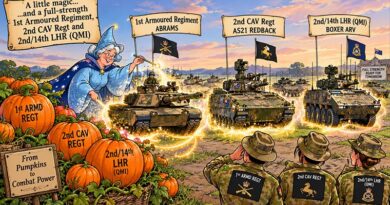
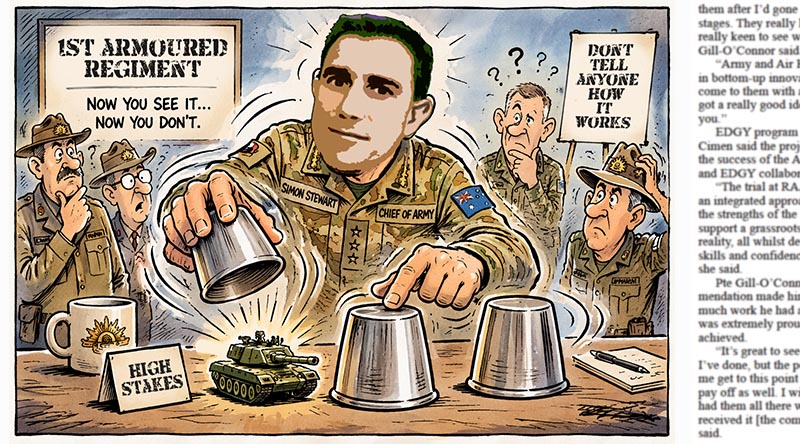
In a long-running campaign, CONTACT Editor Brian Hartigan has published more than 100 of my letters in an effort to bring attention to the injustice involved in relation to 1st Armoured Regiment, i.e. tanks suddenly being stripped from the unit after 75 years’ service operating them – without any form of consultation with stakeholders. Adding to the insult, the unit has been made into a non-combatant, without even an RAAC role.
There is no doubt that the campaign has been successful in raising awareness. Letters typically receive over 1000 views during the course of a few months. One letter relating to the demise of 1 Armd Regt, received almost 40,000 views.
The idea behind the campaign was to try and influence public opinion to such an extent that the CA would be forced to reinstate 1 Armd Regt to its combat role. An impossible task, but what else could be done? Someone had to try.
There was another consideration involved. The RAAC used to be responsible for infantry mobility. Under the Armoured Cavalry Regiment set up, each of the RAAC’s three ARA units had a squadron of APCs, a squadron of tanks, and squadron of Combat Reconnaissance Vehicles. When APCs went to infantry, the RAAC lost the equivalent of a regiment.
It was expected that the Department of Defence would insist that manning levels be maintained, i.e. there be no ‘new’ positions created without a detailed justification.
The infantry take-over of the APCs had been known for some time and the RAAC should have been well prepared (if the hierarchy were doing their job).
What would the new organisation look like? A regiment of tanks and a regiment of CRVs? Possibly three regiments with reduced manning in each? Maybe the opportunity would be taken to integrate units with the ARES?
Unit seniority was 1 Armd Regt, 2 Cav Regt, and 2/14 LHR (QMI); the latter being the junior ARA unit. It was to be expected that this would make way if any change affecting units had to be made. This was the basis of the Corps heritage after all.
To say that stripping the tanks from 1 Armd Regt was a surprise, was an understatement.
But why in heaven’s name was this the case? Surely the RAAC Corps managers weren’t kept completely in the dark? But it seems as if this is what happened.
But, why didn’t they demand to know? How could something so fundamental to the RAAC, not have been anticipated and preparatory actions taken?
The Chief of Army emphasises the importance of trust. It would seem to be a commodity in very short supply.
This would have to be the worst possible example of the betrayal of trust (and abrogation of responsibility) imaginable.
One day the truth will find a way to make itself known; it’s simply not possible to keep something like this a secret forever (unless the collusion involved is endemic).
Lieutenant Colonel Bruce Cameron, MC, RAAC (Ret’d)
.
.
ChatGPT image
.
.

.
.