Unit identity in the RAAC

What happens when a tank regiment that has served the Nation in the same role for 75 years is suddenly stripped of its tanks and made a non-combatant? Is the psychological fall-out involved of concern to anyone?
The experience of the 1st Armoured Regiment Association would suggest that no-body could care less – given the following comments by its members:
“The way that Army senior leadership opted to deal with 1st Armoured Regiment and the main battle tank capability, has been debilitating to many members.”
“The dismissive responses from the Army have only exacerbated the dismay and anger”.
“The veterans believe the Army’s decision is the ultimate betrayal of their service.”

“Their outrage and indignation reflect the traits of institutional betrayal”.
“To be frank, they all feel gutted as they watch the Regiment stripped of its soldiers, tanks and armoured warfighting capability. They see the demise of the Regiment’s esprit-de-corps that they feel they spilt blood to create.”
“They are gutted as they watch all that 1st Armoured Regiment has been during its 75-year history … being trashed.”
“Worst of all, they sense the risk to the lives of soldiers in training and on future operations.”
“They believe that the tanks are being moved into a unit structure that is incapable of training and sustaining the tank capability, let alone commanding it in action and raising rotatable sub-units.”
“They sense the risk this poses to the generations of soldiers who will fight and die in the future defence of Australia’s interests.”
“The pain that Army’s decision has caused 1st Armoured Regiment veterans, particularly those who served in combat in South Vietnam, cannot be understated.”
The last point (below) is very relevant, given that the Chief of Army has made the 2nd Cavalry Regiment a dual-role unit, with two tank squadrons and two cavalry squadrons (a totally incompatible grouping of intelligence-gathering reconnaissance and direct fire support):
“To be combat effective, tank crews and their support need to train under the unified command of a tank regimental structure.”
The decisions which resulted in the disastrous disbandment of 1 Armd Regt and the dual-role catastrophe of 2 Cav Regt were the consequence of the CA’s fixation with the need for an experimentation unit. (Who cares about all the mobile warfare skills that have been lost in the process?)
The honeymoon period (for both 1 Armd Regt and 2 Cav Regt) is well and truly over.
There is no doubt that the RAAC will eventually recover.
BUT, how long will this take and at what detriment to our national defence capability?
The psychology of unit identity is something that probably can’t be measured. Everyone who has served in an Army unit, however, knows what it involves. Esprit-de-Corps is central, as is the heritage and tradition accumulated over the decades. Loyalty goes without saying.
For many, their unit provides a place of belonging; fostering camaraderie and binding them together as a team, one which can function well, even under pressure.
Given that this is well recognised as being the case; why then, would anyone demolish a unit, give it a completely new role, and, moreover … do it secretly, without consultation with its stakeholders?
The answer, of course, is to achieve an agenda which no-one in Defence wants to have publicised (in order to avoid a backlash associated with the demise of Army’s most senior regiment).
There is no doubt that 1 Armd Regt will, in time, return to being the Australian Army’s tank regiment.
Lieutenant Colonel Bruce Cameron, MC, RAAC (Ret’d)
.
.
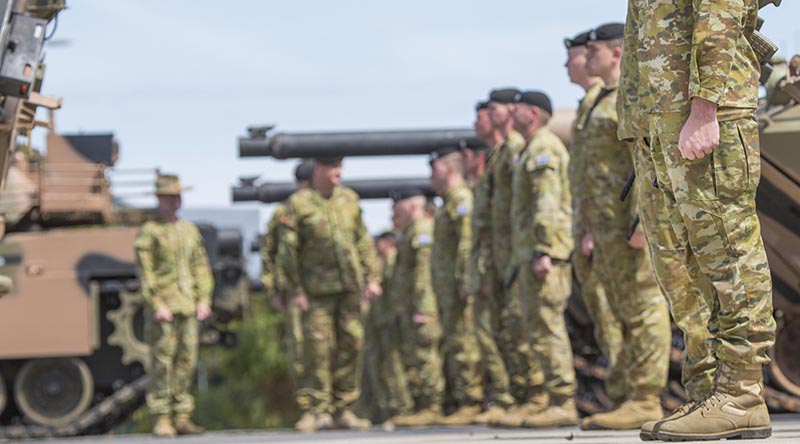
FILE IMAGE: Soldiers officers and vehicles of the 1st Armoured Regiment on parade to mark the 100th anniversary of the Battle of Cambrai. Photo by Corporal Craig Barrett.
.
.

.
.