
Aussie EDDs experience unique Kiwi test

In a significant first, the New Zealand Defence Force (NZDF) has taken the lead in organising and delivering a groundbreaking home‑made explosive training package for New Zealand and Australian explosive detection dog teams.
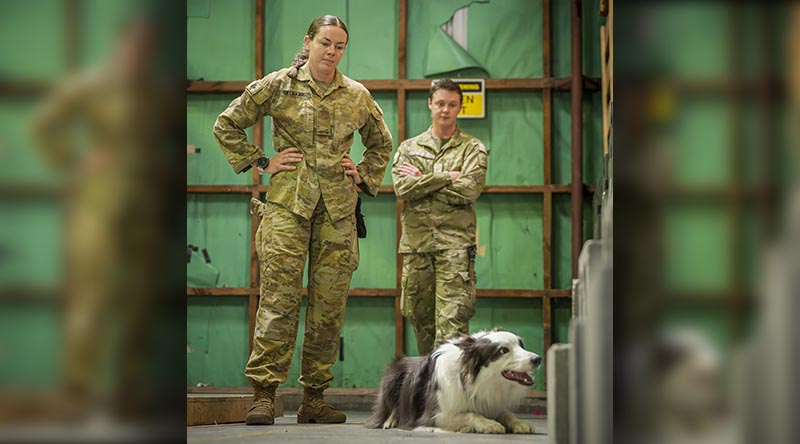
CAPTION: Australia’s 3rd Combat Engineer Regiment Sapper Shonee Gelhaar and EDD Ash, who is indicating the presence of a target odour, is assisted by New Zealand Army’s Lance Corporal Conor Woods. NZDF photo.
Earlier this month, 20 teams of Explosive Detector Dogs (EDDs) and handlers from New Zealand Army’s 2 Engineer Regiment, Australian Army combat engineering regiments, New Zealand Police and Aviation Security came together at Trentham Military Camp.
The aim was to provide a controlled and scientific environment to evaluate the dogs on a variety of home-made explosives samples, made from realistic components by Defence Science and Technology.
NZDF military dogs capability manager Alan Inkpen said it was the first time Australian Army EDD teams had travelled to New Zealand to train.

“It was an excellent opportunity for all personnel and EDDs to train on such a diverse number of odours and sample sizes ranging up to four times larger than ever encountered before,” he said.
The explosives were based on operational knowledge of what the biggest threats were to New Zealand.
The training was designed to stretch and test the dogs using explosives that belong to the same ‘family’.
“We can’t have every different kind of explosive here,” Mr Inkpen said.
“But we’re working on a ‘family theory’ of explosives, where related explosives have a base component and a primary odour.
“In the military world, we push the handlers on identifying the changes in the dog’s behaviour.
“If we use another brand of explosive, the dog might not be perfect, it might get confused, but its behaviour will change.
“The handler has to be able read their dog and inform the search team.”
Dog handler Lance Corporal Henry Wallace, from 2 Engineer Regiment in Linton, handles EDD Wella, a six-year-old female black labrador.
“She’s gone pretty smoothly,” he said.
“Even if it’s not something she’s exactly smelt before, she’s recognised it’s in the ballpark, it has the same makeup as other odours she knows.”
The networking opportunities were immense and it was great to see how the Australians operated, he said.
Aviation Security dog trainer Steve Pike, who came with three teams of dogs, says it was very useful to have significant samples to train on.
“Early on in the week it showed that our dogs train on these sample types on a regular basis.
“But the different scent pictures created by the NZDF team has been a fantastic opportunity for our dogs to work on odours with slightly different compositions.
“Multi-agency exercises are always good for getting different perspectives, training techniques and of course comparing our capability.”
Mr Inkpen said he was a firm believer in sharing the knowledge.
“Interoperability between the New Zealand Defence Force and with our main ally and partner government agencies, has been invaluable.
“It’s opened something of a Pandora’s Box – in a good way – about where we can take this sort of training in the future.
“We’re all in the same fight to make our countries as safe as possible and be ahead of the curve.”
.
.

.
.


