
Simulators put soldiers in the tank driver’s seat
Share the post "Simulators put soldiers in the tank driver’s seat"

A tank driver eases onto a 30-degree side slope, feeling the vehicle lean beneath them as tracks bite into the side of the hill – only they’re not in a tank at all.
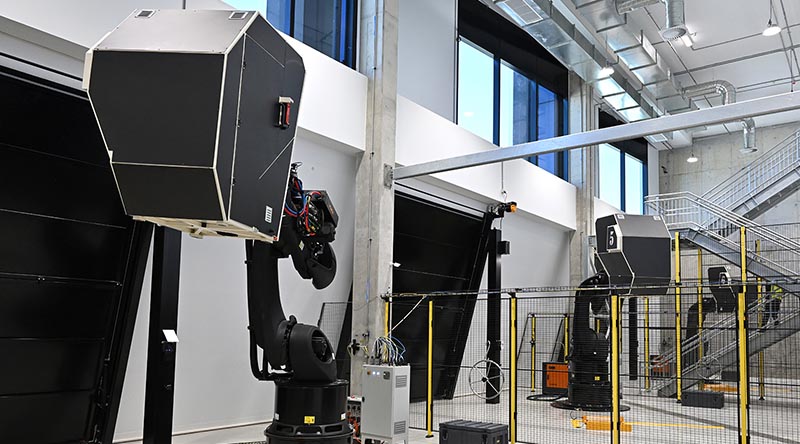
FILE PHOTO: Reconfigurable driver simulators developed by Universal Motion Simulation Pty Ltd, an Australian company from an Army-funded university research project. Story by Corporal Michael Rogers. Photographer unknown.
Soldiers at the Army School of Armour are now training on a new generation of Australian-made driving simulators designed to prepare crews for Army’s future heavy armour fleet.
Defence has invested about $10 million to expand its armoured vehicle simulation capability with the reconfigurable driver simulators (RDS) under the LAND 907 Armoured Combat Program.
The simulators use interchangeable vehicle cabins mounted on robotic motion arms to replicate the experience of driving an armoured vehicle.

Developed by Australian company Universal Motion Simulation, the system allows soldiers to train on the M1A2 SEPv3 main battle tank, M1150 assault breacher vehicle and M88A2 armoured recovery vehicle.
The school also has cabin modules for the Boxer combat reconnaissance vehicle, first delivered in 2024, which are being updated to the Block 2 standard.
Director of Land Systems Division Capability Fielding Team, Colonel Ben Shepherd said the system gave a realistic edge to Army’s simulated training.
“RDS provides a significant enhancement in the Army’s simulation capabilities by enabling a greater throughput of trainees across a greater variety of platforms,” Colonel Shepherd said.
The simulators provide instructors with real-time data on driver performance, including throttle and brake application, gear selection and completion of training scenarios.
Recorded after-action reviews also allow instructors to provide detailed feedback and identify areas for improvement.
The capability is also expected to reduce demand on operational vehicles by allowing drivers to develop core skills in a virtual environment before progressing to real platforms.
Colonel Shepherd said future upgrades would expand the capability.
“The idea is that we can simulate scenarios that are hard to replicate in real life.
“You can’t just drive a tank into an urban environment for training,” he said.
Future enhancements will include littoral environments, beach-landing scenarios, ground-guiding activities and the ability for multiple crews to train together in the same virtual battlespace.
Army plans to expand the facility from six simulator arms to eight, and introduce modules for the AS21 Redback infantry fighting vehicle, to prepare soldiers for the next generation of armoured combat vehicles.
.
.

.
.


