
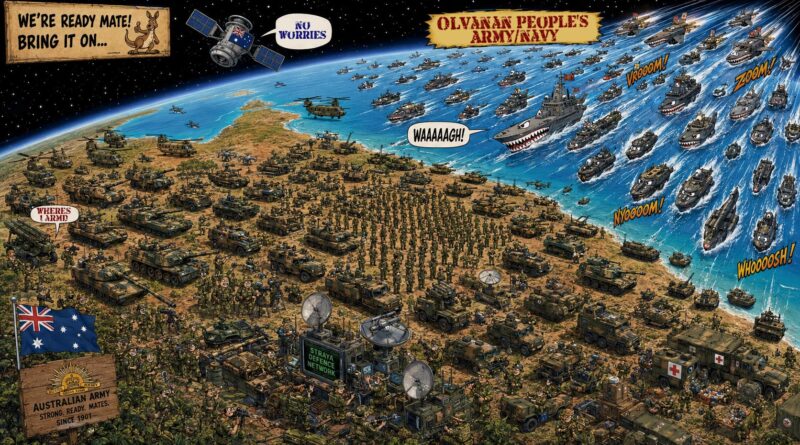
Army’s Role in the Defence of Australia

Can it really be done, or are we pissing into the wind? Can the Australian Defence Force really defend our Nation?
The Australian Army field force is designed to deliver rapid, deployable land warfare capabilities. It is able to succeed in this, because of the logistic support backing it.
The field force comprises a combined-arms land system made up of tanks, combat reconnaissance vehicles, mechanised infantry fighting vehicles, attack helicopters, artillery, infantry, engineers, and signals.
The 2026 National Defence Strategy refers to Army being optimised for littoral manoeuvre and having a long-range strike capability. It goes on to say that it is important “to ensure that Army can secure strategic land positions and provide protection for the force”.
How does Army set about doing this, i.e. securing and protecting strategic land positions?

Obviously, it is a completely separate contingency to littoral manoeuvre. Nevertheless, it begs the question: how many strategic positions can be protected at any one time? Do you split the force to cover each strategic location or do you keep it concentrated and only commit at the crucial time?
If the latter … how well practised is the Army in assessing the critical moment? Do we train with this in mind or is it something that we tend to overlook?
It is obviously something that the Army needs to train for. But is it doing so?
How many exercises have focussed on securing strategic positions? Indeed, what is it that makes some land strategically important? Can we tell now where it is, and practise getting to it?
How will the immediate-lodgement force be positioned … air-landing or parachute, perhaps?
The responsibility for subsequent action would seem to rest heavily on the combined-arms land system. But a central part of this, i.e. the tank regiment, has been made into an experimentation unit, while the tanks themselves have been incorporated into a unit with incompatible dual roles of reconnaissance and close fire support.
Tanks are the ideal weapon system to secure strategic ground. Mobile and armoured, together with massive firepower … exactly what’s needed to make a difference.
Which makes one ponder just how irresponsible the decision was to scrap Army’s only armoured regiment in favour of an experimentation unit!
One has to wonder if the in-coming Chief of Army will seize the initiative and reinstate 3 Brigade as a full armoured brigade; with 1st Armoured Regiment and 2nd Cavalry Regiment each under command of their own battle-group headquarters. Hopefully, she’ll engage with the RAAC Representative Honorary Colonel and resolve earlier differences between the former CA and the RAAC.
Adherents to the saying that “offence is the best form of defence” will be heartened to think that 1st Armoured Regiment may be returned, one day, to its combat role.
Lieutenant Colonel Bruce Cameron, MC, RAAC (Ret’d)
.
.
ChatGPT image
.
.

.
.


Seriously.
Putting on my CDF hat here is a thought, Army’s role is to train the ‘population’ to defend our country.
It then follows Army must maintain a nucleus of all skills, combat and support to enable expansion at time of need.
Think of conscription etc.
It is logical that the entire defence force is readied as such.
Any donkey knows that the defence force is incapable of defending Australia.
The strategy should be to buy time while the country mobilises as in WWI & WWII.
There is no such plan, infrastructure or capability
Our leader’s military and political keep ignoring history to OUR PERIL.
It’s no wonder then as our Military leaders are now defacto politicians/business managers who no longer have war fighting skills.
Back to Civvies hat, Jack