
New Zealand’s Middle East military observers stay positive in conflict zone
Share the post "New Zealand’s Middle East military observers stay positive in conflict zone"

Seeking shelter during missile alerts, handling the tension during inspections, and avoiding explosive remnants of war are the necessities of daily life as a United Nations Military Observer in the Middle East.
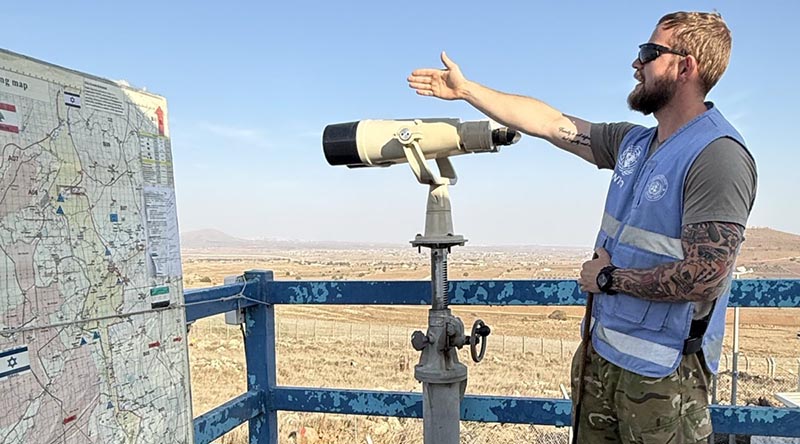
CAPTION: Royal New Zealand Navy’s Lieutenant Chris Wise at an observation post in the Golan Heights. NZDF photo supplied.
The operation is the New Zealand Defence Force (NZDF) contribution to the United Nations Truce Supervision Organisation’s (UNTSO) supervision of armistice agreements between Israel and Egypt, Jordan, Lebanon and Syria.
United Nations Peacekeeping, the largest and most visible representation of the United Nations, seeks to secure commitment and cooperation towards peace and security in volatile environments, particularly through the deployment of peacekeepers.

Over decades, NZDF has supported a number of peacekeeping initiatives, from the Middle East to North Africa and Asia, with the posting of defence personnel to these regions.
Lieutenant Wise is based in the Syrian Golan Heights, monitoring adherence to the 1974 Agreement on Disengagement between Syrian and Israeli forces.
It’s a role that takes patience, resilience and an open mind, says Lieutenant Wise, as well as always being prepared for the worst-case scenario.
His most common tasking is static operations, with his team observing the Area of Separation from a permanent Observation Post for shifts of seven to 14 days. Mobile operations, with car patrols heading into areas of interest, involve inspections and investigations into possible violations of the agreement.
The war with Iran has changed their routines, but he said everyone maintained a positive attitude.
“Everyone’s morale is high. There have been some tense times and we make preparations for worst-case scenarios by ensuring our shelters have enough supplies to see us through if we have to go to ground.”
Some days they experience multiple missile alerts.
“They generally get detected early and we receive a notification to get to shelter. After a safety period we can leave. Time in shelter isn’t actually too long.”
Inspection work has its own tensions, he said. The military observers report their movements around their Area of Operations, ensuring they are tracked at all times.
“You need to be able to clearly explain your purpose in a way that they understand to avoid any unnecessary misunderstandings all while remaining professional, polite, and impartial about the conflict.”
Knowing where it’s safe to drive – or walk – is vital because of unexploded remnants of war.
Captain Taniwha, based in Lebanon, says the magnitude of the situation hit him the most.
“Learning of what has happened there and seeing it with your own eyes are two completely different things.”
“It was a dramatic shift in the security environment when hostilities escalate,” he said.
“We had to adapt to a new lifestyle – long or sleepless nights, the danger of close engagements and heading in and out of the bunkers.
“We have to be mindful of the war unfolding outside our positions and that we’re always prepared to take cover or seek shelter.”
Captain Wooten-Lane, also in Lebanon, says there are constant explosions and calls to head to a bunker. But despite the situation, it was a career goal to deploy and a “huge win” to be selected for Operation Scoria.
“It’s a role where you bring your ability to lead yourself and make smart decisions under pressure,” he said.
“Prior to the war we would be out patrolling South Lebanon. It was awesome to interact with locals and see how they lived their life.
“At the moment we spend a lot of time in bunkers.
“It’s a very different climate.”
.
.

.
.


