NZ infantry platoon completes 90-day deployment in South Korea
Share the post "NZ infantry platoon completes 90-day deployment in South Korea"

A New Zealand Army infantry platoon has successfully completed a highly demanding three-month deployment to the Republic of Korea (ROK) alongside Korean and US forces.
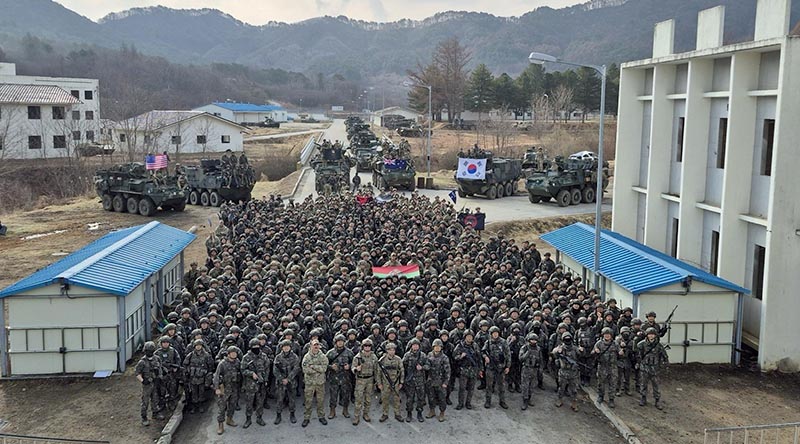
CAPTION: Soldiers of the New Zealand Army, Ngāti Tūmatauenga, pose with their Korean colleagues at the Korea Combat Training Center. Photo supplied.
Operating under the United Nations Command (UNC), the platoon achieved significant milestones with both partner nations across integration, combat readiness, and interoperability.
Based primarily out of Camp Casey with the US Army’s 2nd Infantry Division, this marked the second major deployment of a NZ Army infantry platoon to the peninsula, building on lessons learned following the first successful rotation last year.
Land Component Commander Brigadier Jason Dyhrberg said the deployment was focused on enhancing coalition warfighting capabilities.

“This deployment has provided our soldiers with world-class training opportunities that are difficult to replicate at home,” Brigadier Dyhrberg said.
From large-scale armoured manoeuvres to littoral warfare exercises alongside the ROK Marines.
“It’s also allowed us to share some of the ways in which our soldiers conduct their training and processes, and so it’s been an incredibly beneficial series of exercises for all parties.”
Throughout the 90-day deployment, the Kiwi soldiers engaged in a series of complex, high-intensity training events that tested their tactical proficiency across multiple domains.
It was the first time NZ Army soldiers had partnered with a Republic of Korea Marine Corps landing battalion, using Korean amphibious assault vehicles as part of a simulated coastal assault supported by naval and aviation assets.
Brigadier Dyhrberg said that for the second year running, the platoon also trained alongside Korean and United States Army soldiers at the world-class Korea Combat Training Center, where they executed a gruelling two-week field training exercise, culminating in a 96-hour continuous tactical phase across complex urban and dense, close-country terrain.
“By training alongside our partners in these sorts of environments, it ensures our soldiers are not only highly interoperable but at times interchangeable within a multinational force, which is vital in today’s strategic environment.
“Our soldiers have proudly represented the New Zealand Defence Force, proving our ability to seamlessly integrate with our key partners whilst continuing to honour the legacy of the Kiwis who served on the Korean Peninsula over seven decades ago, and show our ongoing commitment to upholding the international rules-based system.”
.
.

.
.